
Posted: May 25, 2026
Chargebacks are a nightmare for any rental business. Not only do they cost you the money you earned for providing the services, but they also eat up the operational reserves of your business. Chargebacks are a forced reversal of funds initiated by the customer’s bank. They withdraw funds from your merchant account and charge an additional fee while the dispute is being investigated.
Weather cancellations are unpredictable. You cannot predict the weather with 100% accuracy. So, rental companies can only prepare themselves for unforeseen circumstances. Weather-cancellation chargebacks must be prevented, as they cost the company in two ways. The first is the loss of the transaction money plus an additional chargeback fee, and the second is the opportunity cost. When you take money from a client and hold their slot, you reserve a place on the calendar and turn away clients who ask for the same date. This is an invisible loss the business suffers when the first customer for whom the slot was held cancels their reservation, leaving your business with unrented equipment and zero revenue.
A chargeback is not just a lost sale; it is a lost opportunity, lost revenue, and a loss of potential clients that were turned away while the booking was upheld. This means the business is being constantly drained of operational resources and opportunities. Since weather events are unpredictable, you cannot rely on reactive dispute management. You should put in place the exact policy to follow in the event of an unforeseen weather event before it happens.

Friendly fraud refers to when a legitimate customer uses the bank’s chargeback process to force a refund for a transaction they actually authorized. This often occurs due to dissatisfaction or buyer’s remorse.
In the party rental industry, weather-related chargebacks are considered friendly fraud. This happens when the customer realizes that their outdoor event was ruined by bad weather, such as rain. The customer issues a chargeback because they get angry that the merchant didn’t refund them for the inconvenience. The most common reasons for chargebacks include customers claiming that the merchant didn’t deliver the rented equipment.
Friendly fraud of this type occurs mostly because the customer feels entitled to a refund when the event doesn’t go as planned. However, this is wrong because the merchant still rented out the equipment. In such claims, the banks inherently favor the customer. This is especially tricky for the merchant, because the burden of proof doesn’t rest on the customer; it lies with the merchant.
Chargebacks are particularly complex for the rental company; they bypass the merchant’s internal refund policy entirely, and the merchant does not learn until the funds have already been removed from their account. It is crucial for the merchant to distinguish between friendly fraud and legitimate fraud, as the defenses for each require fundamentally different approaches.

The foundation to protecting your company from unforeseen chargebacks is to establish terms and conditions as your primary line of defense. The crucial aspect of developing such policies is to formulate clauses that banks will actually uphold. Having generic “no refund clauses” doesn’t cut it. For protection against weather-cancellation-based chargebacks, a strict no-weather-cancellation clause must be implemented in your terms of service. A weather cancellation clause is a specific, isolated section of the rental contract that dictates exactly what happens to the customer’s money if an adverse weather event occurs.
Establishing a hard cut-off deadline is the next step. It forces the customer to commit. It prevents losses to the company by ensuring that the money is secured once the delivery truck has arrived at its location. Hard cut-offs prevent last-minute cancellations, which are a major source of loss for rental companies. In such an event, the company incurs operational expenses in addition to the transaction amount.
Your policies must clearly outline the financial outcomes derived from the number of days before the event. This means that a clear percentage-based cancellation policy must be implemented. The security deposit must also be managed properly to ensure it covers losses incurred during the idle period. Creating graduated refund tiers ensures that charges and refunds are fair and uniform for every customer. Informing the customer before payment is also a crucial step and will be discussed in later sections.
There is a fundamental distinction between deposits and non-refundable retainers. Deposits are a partial prepayment toward a final physical product or service. Their essential function is to reserve a service in advance and confirm a slot. Deposits are inherently refundable in case services or goods are undelivered. On the other hand, a non-refundable retainer is a fee paid solely to secure the equipment for a specific date. This is legally recognized as a payment for reserving inventory and turning away paying customers.
In legal matters, the terms used in your policies dictate how you can defend your case. Using the word “deposit” in your terms of service actively harms your case. Deposits are refundable, which means your case against a chargeback is already weakened. A “non-refundable retainer” aptly describes the amount taken to reserve the equipment. This means that the customer is not just paying for the tent, but also paying you to turn away potential paying customers.
Stating the percentage breakdown of non-refundable retainers in your policies makes it clear to the bank exactly what portions of the funds remain uncontested. Even if a business chooses to refund a customer out of goodwill, using the “retainer” language gives the business discretion to act of its own accord rather than make decisions under pressure.
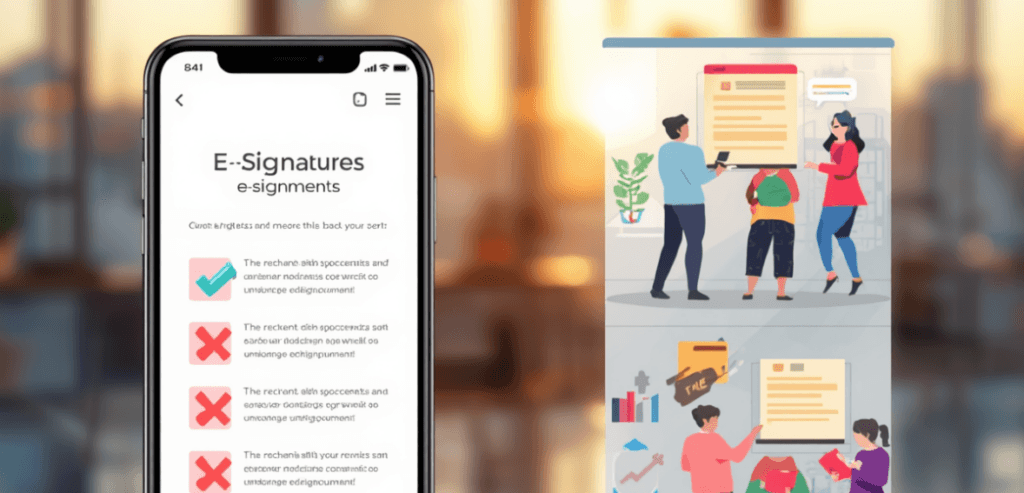
E-signatures are legally binding digital sign-offs captured via software. This is far more secure and verifiable than a physical signature on paper. Most companies implement clickwrap agreements. These agreements are used to ensure that the customer consents to all your policies before proceeding with payments. Clickwrap agreements refer to digital barriers in proceeding to payment, such as ticking the checkbox that reads “I have read and understood all terms of service.”
Verbal agreements might hold for the moment, but are not verifiable later. Relying on verbal agreements is guaranteed to lead to legal troubles in the future. It is more important for you to maintain proper documented proof of activities and agreements because, in the face of a dispute, the burden of proof lies on the merchant. The clickwrap agreement at the digital checkout requires the customer to explicitly acknowledge the weather policy, thereby serving as definitive proof.
Implementing digital signatures must be accompanied by logging backend data, such as IP addresses and timestamps, to verify the credibility of the digital proof. Using Address Verification System (AVS) checks during credit card transactions helps protect your company from fraudulent use of stolen credit cards.
Incorporating a weather policy into your terms of service protects your business, but customers are retained by building trust and maintaining credibility. You should defuse emotional tension for the customer when bad weather is forecast; it prevents panic surges and delays the angry decision to call their card company to issue a chargeback.
Pre-event weather check-in is a standardized outreach via text or email sent to the customer 48-72 hours before their event when bad weather is forecast. This forces a dialogue with the company. A dialogue is often your best shot at resolving impending disputes. Additionally, good-faith efforts are crucial. They refer to documented proof that the merchant tried to resolve the issue and accommodate the customer. Good-faith efforts are viewed favorably by banks in disputes.
Customers usually panic when they see weather forecasts predicting bad weather, but do not hear back from the merchant. If the customer feels abandoned, their panic surges, and they become more likely to issue chargebacks. Sending proactive, automated texts or emails 48-72 hours before the event assures the customer that you are willing to resolve doubts and accommodate genuine reasons.

Rain check, also known as store credit, is the practice of holding the customer’s already paid funds in their account for future use, rather than returning the cash to their credit card. Offering a rain check neutralizes a chargeback. This is because even if the customer files a dispute alleging that the merchant refused services, the merchant can prove it offered equivalent value in the form of store credit. For rain checks to be successful in preventing losses, they must have strict expiration dates. An expiration window is a strict contractual time limit on a rain check that prevents the merchant from incurring indefinite liabilities.
A rain check plays a critical role in preserving the business’s operational cash flow. It protects you from the devastating impact of chargebacks. But you cannot carry an indefinite liability in the name of a rain check; it will lead to future losses and unpredictable cash flow. The terms of the rain check must be explicitly stated in the terms of service. The most important points include the scope of store credits and the expiration window.
The legal safe limit for wind speeds is typically 15-20 miles per hour for inflatables and temporary structures. On the day of the event, rain is an adverse weather event, but winds exceeding the legal safety limit are a direct safety hazard. This can be substantial ground for a merchant-initiated cancellation.
The rental contract must explicitly state that the merchant reserves the unilateral right to refuse delivery of the rental in the event of hazardous weather, such as winds exceeding safe limits. But merely stating this clause isn’t enough. The contract must also lay out the next course of action. It must state the exact refund or store credit policies that apply to merchant-initiated cancellations.
To win a chargeback in this scenario, you must provide proof of a safety hazard. Documenting the National Weather Service wind forecasts on the day of delivery serves as irrefutable evidence.
Winning weather-cancellation chargebacks is not about fighting the bank after the funds are reversed. It is about laying down the terms and policies in such a way that protects your revenue. Vocabulary is an important aspect that shifts the liability. Party rental owners can reclaim their revenue by building policies that leave banks no choice but to rule in their favor.
Deposits are seen as partial payments toward a final product, and are often refundable if the product is undelivered. On the other hand, a non-refundable retainer reserves the equipment and turns away other customers, and is not refundable to the customer.
Yes, a customer can issue a chargeback for almost any reason, regardless of any policy they signed. The burden of proof lies on the merchant to prove that the customer is actually violating the signed contract.
No, in any legal dispute, verbal agreements do not hold up in court. Only written and signed agreements hold in case of disputes.
Capturing IP addresses and timestamps provides verifiable proof that the customer signed the digital document from their own device.
Offering a documented rain check or store credit proves to the bank that you made a reasonable, good-faith effort to accommodate the customer. In disputes, your documented offer of a rain check will often invalidate their claim.