

Posted: May 29, 2026 | Updated: October 07, 2026 at 11:29 AM
There is no absolutely free software available in the market. Every software product that markets itself as a $0 subscription almost always carries hidden charges. Net donation revenue is the actual amount deposited into the nonprofit’s account after deducting platform and processing fees. Freemium pricing is a model used by software companies that charge $0 upfront but monetize through transaction fees or paywalls for premium features.
Nonprofits frequently select a donor platform based on the advertised “$0 monthly fee.” It makes you completely overlook the fact that transaction and platform percentages can cost you thousands of dollars in the long run. Nonprofits are now opting for “donor-covered fees” and “donor tips” to cover their credit card processing fees. This has fundamentally changed how nonprofits approach revenue.
Platform pricing plans are intentionally complex — mixing flat-rate, percentage-based fees, and separate payment processing fees, which makes comparison between multiple platforms difficult.

Donor platform costs are a critical aspect of nonprofit revenue because they compound. Compounding fees refer to the concept that small percentage cuts taken from recurring monthly donations add up to massive revenue leaks over the long term. On the other hand, effective cost refers to the true cost of a platform. It is calculated as the final cost incurred by the nonprofit after adding up the subscription fee, transaction cuts, and payment processing fees charged by the platform company.
Recurring donations are the lifeblood of nonprofits. Percentage-based cuts on every transaction capture a significant portion of the recurring revenue, silently draining it without the staff even noticing the leaks. Most nonprofits try to avoid paying for software. In a bid to save $99 per month in software fees, nonprofits opt for free software without realizing that the actual costs of free software are actually twice or even three times the subscription fees of a paid option.
Another challenge with free software is building donor trust. High fees directly impact donor trust — if a donor pays $100 to a nonprofit, they will be frustrated to know that only $93 reached the mission. This loss of trust could result in a fall in donation volumes. Also, high transaction fees create a ceiling on your nonprofit’s growth. Nonprofits rely on increasing transaction volumes to achieve successful growth; high transaction fees mean your processing costs increase in proportion to your transaction volume. The success of fundraising campaigns depends on the volume and average donation amount, but transaction-based software caps it because your software costs also scale aggressively instead of remaining fixed.
Upgrading to a paid monthly plan with a 0% transaction fee is often a better alternative to free software. It helps you budget your software costs and keeps operational costs more predictable.
Before diving deep into the most popular nonprofit management software, let us take a quick look at their market positions, ideal user bases, and core philosophies. There are two key concepts you must understand here: plug-and-play widgets and all-in-one CRM. Plug-and-Play widgets are simple forms that embed directly into an existing website, such as WordPress or Squarespace, without requiring a whole new tech setup. On the other hand, all-in-one CRM is a platform that not only processes donations but also actively manages donor profiles, email marketing, and ticketing in one place.
Donorbox is a powerful, lightweight form builder. It is designed to seamlessly integrate into the nonprofit’s existing website. The primary focus of Donorbox is recurring giving and global payment methods.
On the other hand, Givebutter positions itself as an all-in-one, community-focused platform. The primary features of Givebutter are forms, peer-to-peer campaigns, and event ticketing. It also features a “donor tip” that keeps the software free for the organization.
Funraise is built for bigger nonprofits. It provides a robust, data-heavy CRM and fundraising suite meant for organizations scaling up. It caters to needs such as deep reporting, automation, and enterprise-grade tools.
While Donorbox is often the primary choice because of its simplicity and setup, Funraise is the go-to choice for large nonprofits that need more advanced tools to track donor data and market their campaigns. Givebutter, on the other hand, is seen as a better choice for peer-to-peer fundraising. Revenue-wise, Donorbox and Givebutter dominate the $0-$1M revenue space, while Funraise often targets nonprofits netting around $500k-$5M.
Although these comparisons hold, none of the platforms is “inherently better” than the others. These platforms cater to different needs and must be seen as different phases of a nonprofit’s growth rather than a single lifetime choice.
The vocabulary of donation pricing is complex for nonprofit owners. Understanding the pricing models and their significance is crucial to making the right choice. A platform fee is the percentage the software company charges to cover the cost of its own servers. On the other hand, the payment processing fee is a non-negotiable fee charged on every transaction. Usually, it is a percentage of the transaction amount or a flat-rate fee. A donor-covered fee is a checkbox on the checkout page that asks the donor to cover processing fees, so the full amount of the donation goes to the charity.
Almost every transaction involves two cuts: the first is the platform fee, which the software provider charges to cover its own server and operational costs to keep the software running. The second is the payment processing fee, charged by payment processors such as Stripe or PayPal.
Payment processing fees are non-negotiable; they are charged by every payment processor. With IRS exemptions such as 501(c)(3), nonprofits can secure lower processing rates. On the other hand, platform fees vary significantly and are completely controlled by the software company. Nonprofits must read the fine print here, as the platform fees can typically range from 0% to 5%.
The “optional donor tips” are yet another method for securing credit card processing fees from donors. The donor covers the processing fees so that the donated amount reaches the charity.
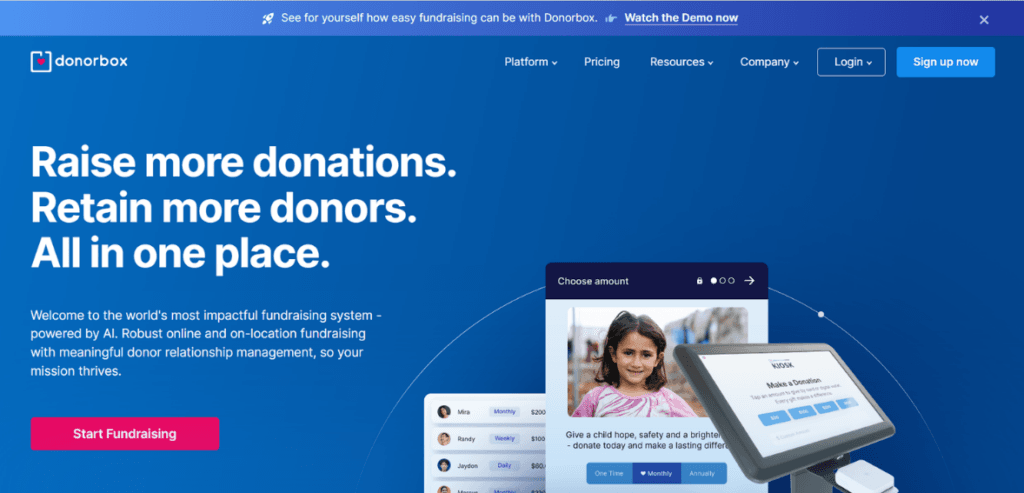
Image Source
Donorbox is a powerful, lightweight platform designed for small nonprofits. The simplicity and fast setup of Donorbox make it an excellent choice for small nonprofits. Let us dissect the cost breakdown of subscription tiers to understand the pricing and the effective cost for a nonprofit.
The Standard Plan is Donorbox’s entry-level tier with no monthly fee. Donorbox markets the “Standard Plan” as “free to start” but charges a baseline platform fee in addition to the standard payment processing fee.
Donorbox charges a higher platform fee, typically around 2.95%, on its Standard plan, which makes it quite expensive. Donorbox also provides add-on purchases for premium features such as event ticketing, memberships, or peer-to-peer fundraising. The add-on charges are applied as extra percentages on top of the platform fees. Donorbox allows nonprofits to ask their donors to cover the processing fees. However, if the donor refuses, the nonprofit absorbs the high processing costs.
Its “Pro Plan” introduces a flat subscription fee of around $139- $150 per month, while the platform fee is significantly lower at around 1.75%. This acts as a safety net for high-volume fundraisers. Although it does not provide an all-in-one CRM, it easily integrates with popular platforms to streamline operations.
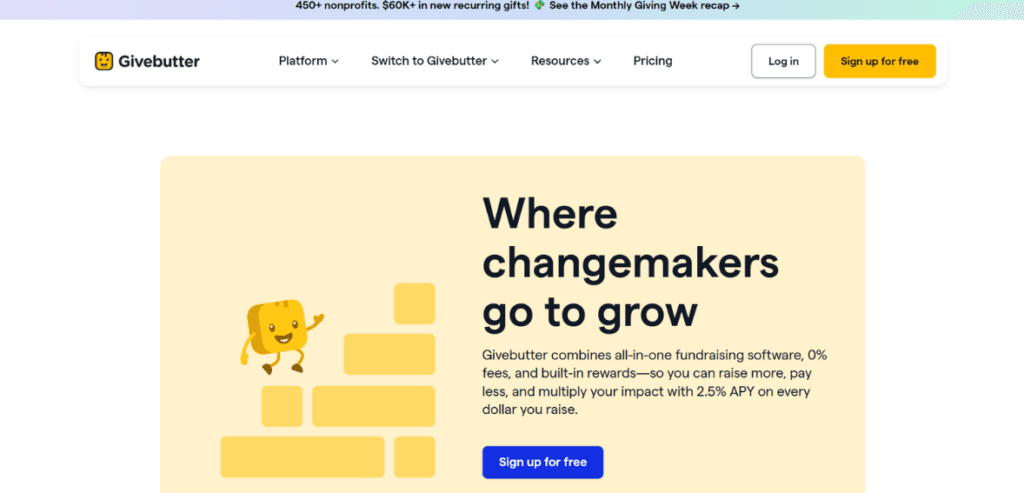
Image Source
Givebutter introduces a donor tipping model into its software. At checkout, donors are provided the option to enter any amount they’d like to give directly to Givebutter to keep the software free. These donor tips are optional but can help the nonprofit save on platform fees. With its tipping model, Givebutter provides truly free software. It does not charge a monthly subscription and can operate with a 0% platform fee, relying on donor tips to cover software costs.
If a nonprofit feels embarrassed to ask its donors for tips, it can disable donor tips on Givebutter. However, Givebutter will charge a platform fee ranging from 1% to 5%, depending on the campaign type. Apart from donor tips, standard payment processing still applies to every transaction, though Givebutter offers reduced rates for ACH transfers, which are highly beneficial for major gifts and recurring giving.
Although the pricing is very transparent, the checkout sometimes feels cognitively heavy to the donor. However, Givebutter provides an impressive suite of robust features — a basic CRM, event ticketing, peer-to-peer fundraising, and email/text campaigns, which makes it an incredibly cost-effective choice.
Funraise provides a premium, feature-rich model for large nonprofits. Funraise offers a subscription-based model and an enterprise-grade CRM. It is structurally different from Donorbox and Givebutter, as it operates as a SaaS platform with prices ranging from $99 to $150+ per month, often billed annually. For smaller organizations, such as those with revenue under $1M, it occasionally offers entry-level tiers. These are not easily accessible; these tiers are highly gated and often carry platform fees of up to 5% on top of payment processing costs.
The cost of Funraise includes advanced features such as automation, intelligent donation amount suggestions, donor self-service portals, and custom deep reporting. These features provide the organization with an information edge that allows it to design campaigns and plan outreach to maximize donations.
Although Funraise is feature-packed software, it is not the best choice for volunteer-led or small nonprofits. This is because it requires a greater financial commitment, making it an overhead burden for organizations accepting only a few monthly gifts. The ROI of Funraise entirely depends on the size of the organization using it. Since costs remain nearly fixed for the higher tiers, nonprofits with high transaction volumes can benefit from it.
After a detailed review of all three nonprofit management platforms, Donorbox is the best choice for small nonprofits and volunteer-led organizations. It allows for seamless embedding and fast setup. Givebutter is the ideal choice for nonprofits that are just starting out and cannot pay for separate software. For very large nonprofits that require enterprise-grade features, Funraise is the right choice. The goal is not to find software with absolutely $0 fees, but rather to find software that fulfills current needs.
We keep our nonprofit payment articles together in Nonprofit Payment Resources; see it for more on donor platform costs.
Givebutter is technically the cheapest software for small nonprofits. With its donor-tipping model, the software remains truly free for a nonprofit.
Donorbox’s Standard plan does not charge a monthly fee; it charges a platform fee of around 2.95% plus add-on percentages for advanced features. The Pro plan introduces a flat monthly subscription of around $139-$150, with a reduced platform fee of around 1.75%.
The donor-covered fee model is a pricing model in which the nonprofit asks its donors to cover its payment processing fees.
Funraise is a feature-packed, enterprise-grade platform that provides advanced features required for nonprofit management and reporting. However, for small nonprofits, it is an expensive overhead to carry, making it a bad choice for small organizations.
Although you cannot avoid payment processor fees entirely, your status as a nonprofit allows you to get some discount on the payment processing percentages. With the IRS 501(c)(3), payment processors allow you to claim discounted processing rates on your donations.