
Posted: April 24, 2026 | Updated: October 06, 2026 at 6:04 PM
The biggest misconception about selling a gift card is that it creates instant profit — that’s not true. You need to understand the difference between cash flow and revenue. Cash in the register does not equal recognized revenue on the books.
The global gift card industry is rapidly expanding and is currently valued at $1 trillion. It is projected to exceed $3 trillion by 2030–2034. During holidays, every business experiences a huge surge in gift card sales. However, gift card sales do not directly translate into revenue. It may feel good to see a sudden spike in sales, but it is rarely direct profit. Gift cards are essentially zero-interest microloans extended by your customers.
Managing gift card liability and breakage is the difference between accurate financials and an audit nightmare. Imagine this: a restaurant celebrates massive December cash flow but realizes in January that it has to provide food and labor for “free” when the cards are redeemed. Gift card sales create a “phantom” revenue boost and increased cash flow — but the business still owes its customers the goods or services it is obligated to provide in exchange for the gift card when redeemed.

You need a clear understanding of the accounting mechanics of gift cards and deferred revenue. Deferred revenue is the money received for goods and services that have not yet been delivered. It is one of the most complex revenue streams to handle because you have to manage operational cash received today in a way that still covers the costs of services owed.
Now let’s look at gift card liability. The line item on a balance sheet representing the total outstanding value of unredeemed gift cards is called gift card liability. In other words, gift cards not yet redeemed by customers are potential debts that must be repaid unless they expire.
When a customer buys a $50 gift card, your cash increases by $50, but your revenue increase is $0. This is because the $50 will be repaid in goods or services when the customer returns and redeems the card. Revenue is only recognized when the “performance obligation” is fulfilled. A performance obligation is the handing over of goods or services promised in exchange for the money received.
You need to understand the dangers of using gift card cash flow to cover operational expenses before the cards are redeemed. It can push your cash flow into the negative and force you to take out short-term credit to cover operational costs once gift cards are redeemed. Additionally, investors and lenders scrutinize deferred revenue during M&A or funding rounds.
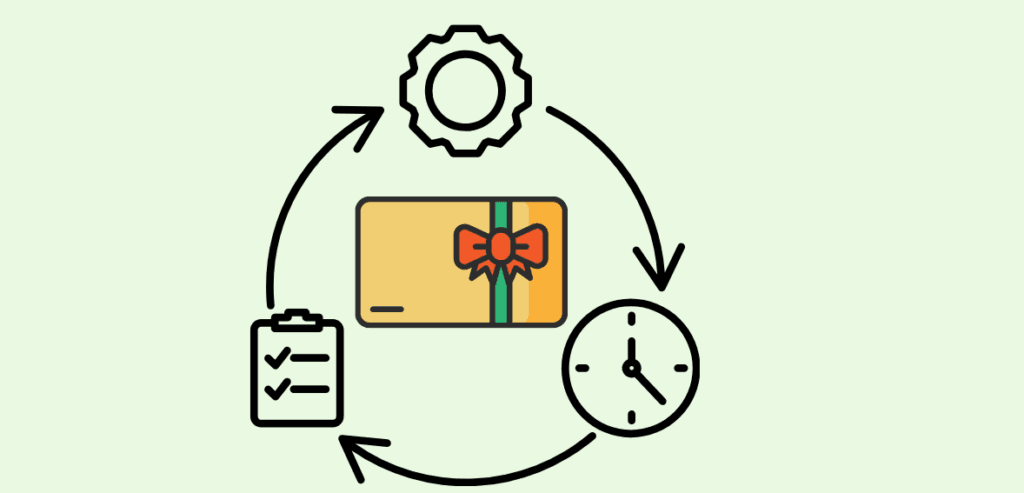
Now that you have an overview of how gift cards work, the next step is to understand their financial lifecycle. You need to understand how a single gift card moves chronologically through your financial statements. To begin with, there are two important concepts to grasp: revenue recognition and the difference between the balance sheet and the income statement.
Revenue recognition is the accounting principle that determines when revenue is recognized. However similar they may sound, the balance sheet and the income statement are two very different documents. A balance sheet tracks what you owe, while the income statement tracks what you have earned.
Now let’s look at the financial cycle of a gift card across its various phases.
The customer buys a gift card. This is known as the activation phase. In this phase, both the cash account and the gift card liability increase. Only the balance sheet is updated, as no net income has been earned.
Let’s suppose the customer bought a $50 gift card. Partial redemption occurs when a customer redeems only a fraction of the gift card’s original value. Suppose that out of the $50 in the above example, the customer redeems only $30. In such cases, liability drops by the redeemed amount — $30 in this example. The $30 revenue increase is recognized. This recognized revenue is transferred from the balance sheet to the income statement. In this phase, the COGS (Cost of Goods Sold) is also recorded.
After a partial redemption, some money remains on the gift card. In the above example, the leftover balance is $20. This leftover balance stays in the liability bucket of your business.
In this phase, the final resolution of unspent funds happens.
Understanding the various phases in the financial lifecycle of gift cards is only half the work. Mapping this lifecycle is impossible without an integrated POS-to-accounting pipeline.

After understanding the various phases of the gift card financial lifecycle, you need to understand how businesses can legally and accurately turn unredeemed liabilities back into recognizable revenue. For this, you need to understand breakage and proportional recognition in detail.
Breakage refers to the recognized revenue from gift cards that are expected to remain unredeemed. It is important to record breakage; otherwise, it ruins balance sheet figures and skews income statements. Recognizing breakage revenue in proportion to the pattern of actual redemptions is known as proportional recognition.
Breakage is not just “waiting for a long time and taking the cash.” It requires a methodical accounting approach, such as ASC 606 / IFRS 15. You need to understand the concept of “remote likelihood” to manage breakage revenue. It refers to determining the exact point at which a customer is highly unlikely to ever use that gift card. It is computed by analyzing historical customer behavior to determine the time period after which a gift card has the lowest probability of being redeemed. In simple terms, remote likelihood is the exact point at which gift card revenue is transferred to the income statement.
Proportional recognition is calculated by analyzing historical data. For example, if historical data shows 10% of cards are never used, you recognize a proportional fraction of breakage every time a card is legitimately redeemed.
You should use a “safe harbor” timeframe — for example, 24 months of inactivity, which is common, provided your state laws allow it. The financial impact of breakage is huge. Breakage is nearly 100% margin profit since there are no associated COGS.
You need to understand the critical legal risks of gift card programs and be able to distinguish between breakage and escheatment in order to avoid legal problems. Escheatment refers to the legal process of transferring unclaimed property, such as unused gift card balances, to the state. The CARD Act of 2009 is a federal law that restricts expiration dates and inactivity fees on gift cards.
The harsh reality of gift card escheatment is that you don’t always get to keep the breakage. Many states classify unredeemed gift cards as unclaimed property. You also need to understand the jurisdiction rules around escheatment. State laws vary wildly. You generally follow the laws of the state where the customer lives, or your state of incorporation — Delaware, for instance, is known for aggressive escheatment audits.
Another key detail to pay attention to is expiration dates. Federal law requires that cards not expire for at least 5 years, but many states ban expiration dates altogether. Inactivity or dormancy fees on gift cards are also a critical factor, heavily regulated. The dispute losses are huge and rarely worth the legal headaches, so most retailers choose to comply with these policies.
You should also be aware of audit risks associated with gift card programs. States actively audit multi-location brands for unclaimed property as a source of state revenue. As mentioned above, in most states, unredeemed gift cards are considered unclaimed property, which puts your business on the radar for a state audit.
A closed-loop system means gift cards that can only be redeemed at your specific brand or franchise. Put simply, if a gift card is redeemed only at a specific brand’s store, it is part of a closed-loop system. Another concept you need to understand is reconciliation. It is the process of matching POS data with the general ledger to ensure accuracy in your account books. The steps involved in tracking gift card data and the practical implementation of these systems are detailed below.
Manual tracking fails at scale because it is error-prone. Manual reconciliation often leads to double entries, data redundancy, and operational chaos. The solution is to ditch spreadsheets entirely and replace them with relational databases synced with real-time POS and account activity.
Make sure your POS system tags gift card sales as a liability, not as standard sales.
Suppose Store A sells the card and Store B redeems it — you need to make sure systems are in place to move and manage the funds internally.
Set up automated reporting for aging liabilities. The standard reporting periods are 30, 60, 90, and 365 days.
The finance team should reconcile the POS gift card liability report against the accounting software balance sheet on a monthly basis. This helps you stay under the radar during state audits and provides proof to defend gift card liabilities.
Now that you understand the liabilities associated with gift cards and how these liabilities must be managed in your accounts, it is imperative to be aware of the most common mistakes retail owners make when managing gift card revenue — mistakes that often cost them dearly. For this, you need to know what a sales tax error means. A sales tax error occurs when tax is applied at the wrong stage of the transaction.
We have compiled a list of the most common mistakes business owners make so you can stay aware and avoid repeating them.
Gift cards are incredibly profitable, but only if the underlying financial tracking system is solid. You need to understand the difference between cash flow and revenue to better manage gift card sales. The first step is to stop viewing gift cards as “accounting headaches” and start viewing accurate gift card tracking as a sign of “financial maturity.”
With the right financial tracking systems and reporting, you can turn the financial obligation of gift cards into sustained growth for your business.
No. Gift cards are considered cash equivalent. You apply sales tax on gift cards only when they are redeemed, not when they are sold.
Outstanding gift card liabilities are treated as business debt. The buyer will require you to deduct the liability from the purchase price of the business.
The best practice is to reconcile your POS gift card reports with your accounting general ledger at least once a month to catch discrepancies before they compound.
It is an internal financial system used by multi-location brands. It ensures that the specific location where a gift card is redeemed gets paid the revenue, even if a different location originally sold the card.
Yes, but you cannot claim it instantly. You have to wait until the statistical likelihood of the card being redeemed becomes “remote” according to your company’s historical data. After that period, you can claim breakage on the lost card.
Gift card liability and breakage: one piece of running payments in a restaurant. The rest of our restaurant payment guides are in Restaurant Payment Resources.