
Posted: December 06, 2024 | Updated: January 20, 2026 at 1:22 PM
The U.S. restaurant industry is projecting growth in restaurant holiday outlook 2025, with economists forecasting $1.5 trillion in annual sales. This optimism extends into the holiday season, as consumers show enthusiasm for dining out. Reports from last year show that roughly two-thirds of adults (63%) planned to dine out over the holidays, while about half (48%) planned to order takeout or delivery.
Successful restaurant operators recognize the value of aligning their offerings with holiday dining trends to build brand visibility, attract new customers, and drive revenue. With 80% of diners willing to try a new restaurant when offered a discount or promotion, leveraging holiday-specific deals can attract new patrons and encourage customer loyalty. This holiday outlook explores the opportunities available to restaurants during the 2025 holiday season.
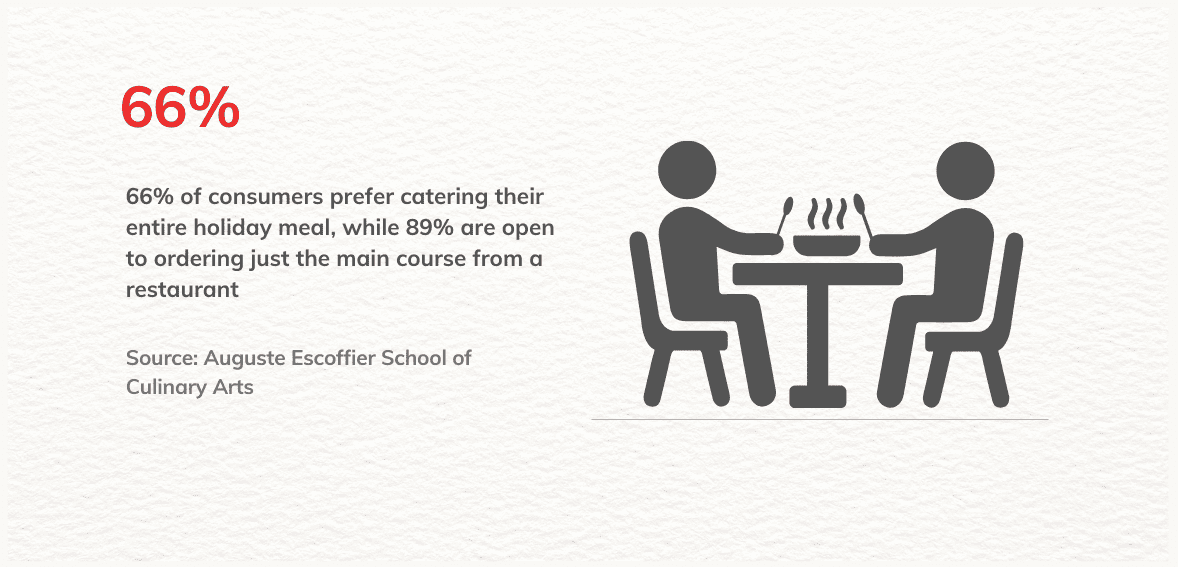
Source: Auguste Escoffier School of Culinary Arts
Industry sales for the November–December period grew modestly, as some reports expected. The National Retail Federation (NRF) projected the U.S. holiday sales (all retail, including restaurants) to rise 2.5–3.5% in 2024.
Restaurant operators generally mirror this trend – the NRA reports that a strong majority of consumers would use restaurants more if they had more money. Many operators are planning promotions to boost traffic in 2025 – nearly half (47%) will add new discounts or value deals to attract customers.
Holiday diners are seeking both convenience and experiences. In late-2023 surveys, 66% of consumers ordering holiday meals planned to buy entire meal bundles from restaurants, and 89% would rely on restaurants for at least the main course (vs. sides, appetizers, dessert). Generation gaps are evident, just for example, 82% of millennials factor in takeout/delivery options when choosing a restaurant, compared to only 53% of baby boomers. Younger diners are also more likely to use restaurants to avoid holiday grocery shopping (75% of millennials, 65% of Gen Z) than older groups (57% of boomers). These preferences suggest restaurants that emphasize off-premises convenience (curbside pickup, easy meal kits) as well as enticing in-restaurant experiences can capture a broad audience.
Historical holiday events also drive demand. Thanksgiving and New Year’s Eve remain key occasions. According to a survey, 36% of diners plan to celebrate Thanksgiving at a restaurant, whereas 88% plan to celebrate at home (ordering in or visiting family). In contrast, New Year’s Eve is hugely popular for dining out, with over 60% of diners planning to visit a restaurant or bar on New Year’s Eve and 55% on New Year’s Day. Operators can leverage these peaks by offering special New Year’s menus or holiday feast packages (dine-in and takeout) to maximize revenue.

| Dish | % Americans who say it is a favorite |
| Turkey | 74% |
| Mashed Potatoes | 67% |
| Stuffing | 64% |
These top Thanksgiving items (turkey, mashed potatoes, stuffing) remain perennial favorites, indicating demand for classic holiday menus. Regional variations do occur, for example, 50% of Northeasterners list apple pie as a favorite Thanksgiving dessert, while Southerners favor pecan pie (40%) and green bean casserole (43%). Such insights help operators tailor menus and promotions by region.
For Christmas, roasted potatoes were the most popular dish, winning 76% of head-to-head matchups. Mashed potatoes followed closely at 75%, with turkey at 73%.

Cost remains on consumers’ minds. A holiday survey found nearly half (44%) of shoppers were concerned about budget, and 91% planned to spend the same or less than last year. 52% said they expect to go out to restaurants less during the holidays than in prior years. To reach budget-conscious guests, many restaurants are highlighting deals, loyalty rewards, and bundled pricing (e.g., family feast packages). Indeed, 47% of operators intend to add new discounts, deals, or value promotions in 2025 to drive traffic.
Takeout and delivery remain crucial. A US Foods survey found that about 57% of Americans prefer ordering takeout/delivery over dining out. Holiday surveys echo this, as in 2023, 48% said they would order holiday meals to-go. Younger diners especially prize convenience, as 82% of millennials and 86% of Gen Z look for off-premise options. Restaurants are responding by improving online ordering, partnering with delivery platforms, and offering contactless pickup. For example, many eateries now offer order-ahead holiday packages (e.g., pre-cooked turkeys or multi-course dinners to finish at home) through their websites or apps.
Despite budget concerns, consumers seek memorable experiences. A 2025 outlook reports that 64% of full-service customers (and 47% of limited-service) prioritize the experience over price. A survey found 67% of holiday diners want more than a standard reservation – they crave themed dinners, tasting menus, pop-up events or at-home experiences. Many restaurants plan special holiday events (wine pairing dinners, cooking classes, festive buffets) to capture this demand. Indeed, such “special experiences” often generate 30% more revenue than ordinary covers. Operators offering unique holiday concepts (e.g. a New Year’s Eve tasting menu or Hanukkah feast at home) can stand out and drive higher ticket values.
The broader U.S. economy in 2025 is expected to decelerate. National Restaurant Association economists project real GDP growth of only 1.2% in 2025 (down from 3% in 2023-24). Labor market expansion is expected to continue, but at a more modest pace (about 1 million new jobs in 2025). Unemployment remains low (4.2% as of April 2025), which supports consumer spending, but wage-driven inflation is “sticky.” The NRA expects overall inflation (CPI) to be 3.6% in 2025, above the Fed target.
Rising prices are straining household budgets. NRA data show disposable personal income growth slowing (projected +1.4% in 2025, down from +2.7% in 2024). Retail and restaurant spending growth has cooled accordingly. In mid-2024, inflation-adjusted restaurant sales were flat to down slightly, despite rising menu prices. Consumers say they will be prudent because a study found 91% of shoppers plan to spend the same or less on this year’s holidays compared to last year. Many will seek deals, with 43% saying they’ll shop at retailers offering the steepest discounts.
These trends likely extend to restaurant dining as price promotions, early-bird specials, and bundled offerings can appeal to value-driven guests.
Not all signals are negative. The NRA’s State of the Industry report notes that 9 in 10 adults enjoy going to restaurants, often for meals they can’t easily cook at home. On-premises dining is the long-term growth focus for most operators, as 90% of fine-dining and 87% of casual operators say increasing in-restaurant business is more important than off-premises. As consumer confidence ebbs and flows, restaurants that deliver good value and a compelling experience should remain attractive. Loyalty programs and targeted marketing will be key; 36% of operators are prioritizing digital loyalty and promotion tools in 2025.

The corporate and private holiday party season is rebounding. In 2024, 81% of employees planned to attend company holiday parties (up from 69% in 2023), and 43% of businesses were boosting budgets, averaging about $44 per guest.
Food is the highlight, as 78% of employees say they’re most excited about the food at workplace holiday parties. This trend from 2024 will continue to strengthen into 2025. Restaurants can capitalize by marketing corporate catering and party packages. Heavy appetizers (34%) and station-based spreads (28%) are popular at parties, and informal “grazing” stations or portable buffet items are in demand for office events.
Simultaneously, many consumers are hosting more casual gatherings at home. Data suggest nearly 36% of people will celebrate Thanksgiving or other holidays in a restaurant or bar, whereas a large majority (88%) plan to celebrate at home (through gatherings or ordering in). This points to robust takeout opportunities. Savvy operators offer heat-and-eat family meals (turkey dinners, party platters, etc.) to cater to home hosts.
Restaurants often package items (e.g. take-and-bake dinners, sandwich kits) for easy at-home finishing. Adding value through bundled sides, desserts, or “next-day” options (leftover sandwiches, brunch kits) can boost the per-order ticket. Consumer preferences for outsourcing holiday meals vary:
Online ordering and third-party delivery remain essential. While 2024 saw talk of “post-pandemic” normalization, consumers continue to crave convenience: surveys indicate that roughly 30–50% of Americans use delivery or takeout a few times per month.
During the holidays, operators report increases in delivery orders: In a 2023 NRA survey, 34% of operators saw an uptick in takeout/delivery orders. To manage this, many restaurants are streamlining digital channels. Some chains are building omnichannel platforms (own apps + partners) to reduce commission costs. Others invest in in-house staff or “ghost kitchens” dedicated to off-premises. Technology upgrades are underway: about 17% of restaurants plan POS/back-office system upgrades, 7% are adding automation (kiosks, robotics). These investments help process higher volumes and improve accuracy during holiday peaks.
The holidays are also big for digital gift cards. In 2024 NRA surveys, 59% of adults said they planned to give restaurant gift cards for the holidays. Younger generations lead this trend. For example, 74% of Gen Z and 70% of Millennials said they would give restaurant gift cards, versus 54% of Gen X and 44% of Baby Boomers.
This aligns with data showing a resurgence in gift card sales. According to a report, there was a 13.2% jump in dollars spent per card on Black Friday 2024 vs 2023, and a 17.7% higher spend over the Thanksgiving weekend. Notably, data showed that in-store (physical) gift card sales ($7.8M) outpaced digital ($7.3M) in late 2024, indicating renewed interest in traditional gift-card purchases at checkout. Offering promotions on gift cards (e.g., bonus value, multi-buy deals) can drive holiday revenue and future visits.
| Generation | % Who gave restaurant gift cards |
| Gen Z (18–25) | 74% |
| Millennials | 70% |
| Gen X (40s–50s) | 54% |
| Baby Boomers | 44% |

Surveys indicate consumers remain cautious. 52% of shoppers intend to dine out less during the holidays. Although many still plan modestly higher spending on food and gifts (43–44% of households say they’ll splurge on these categories), the overall trend is flat-to-down. For restaurants, this means that attracting price-sensitive diners is critical. Operators are emphasizing loyalty programs and partnerships (e.g. credit card rewards, dining subscriptions) to capture spending that might otherwise go to retail.
Millennials and Gen Z dominate holiday restaurant usage, while older diners are more conservative. For instance, only 63% of boomers expected to dine out over the holidays vs. 86% of Gen Z. Younger diners are also more experimental, they’re more likely to try new menu items (in a familiar format) and follow social media food trends during the holidays. By contrast, older segments stick to classics and known favorites. These shifts are shaping menu decisions, many chains are introducing “TikTok-inspired” sandwiches or desserts to appeal to younger guests, while maintaining traditional holiday entrees for longtime patrons.
Geography still matters for holiday menus. In the Midwest and South, comfort sides like green bean casserole (43% favorably) and candied yams are extremely popular, while the West shows higher interest in lighter sides (e.g., salads at 36%). Restaurants with multi-state footprints are adjusting – a casual chain might push holiday salads and smoothies in its California locations, while highlighting classic pies and decadent sides in Texas. Understanding these regional tastes – gleaned from point-of-sale data and national surveys – helps tailor holiday offerings and marketing.
The table that follows highlights key metrics for Americans’ dining-out expenses: it shows the average monthly spend per person in 2024 along with projected amounts for 2025, calculated using both a 4.1% rise in full-service meal prices and a broader 3.8% increase in all away-from-home food costs. It also presents the average cost per holiday meal in 2024 and its corresponding estimates for 2025 under each inflation assumption.
| Metric | 2024 Actual | 2025 Projection (4.1% inflation) | 2025 Projection (3.8% inflation) |
| Average monthly dining-out spend | $191 | $199 | $198.50 |
| Average holiday meal cost per meal | $24.28 | $25.27 | $25.20 |
Turkey still reigns supreme as 74% of Americans ranked it as their favorite Thanksgiving dish. Other staples follow with mashed potatoes (67%), stuffing (64%). Even so, some sides and desserts polarize by generation and region. For example, cranberry sauce was cited as a top 5 least favorite by 27% of Americans, while mac & cheese is scorned by Boomers (27% least favorite) but beloved by younger families. Restaurant operators tap into these insights by balancing menus, offering alternative mains (e.g., prime rib, vegetarian loaves) and modern twists (like sweet potato salads) alongside traditionals to appeal broadly.
Beyond Thanksgiving, holiday menus span cultural traditions. Comfort dishes like sweet pies, mulled cider, and spiced desserts trend during Christmas and New Year’s. Some operators report rising demand for international holiday fare (e.g. Peruvian tamales, Filipino pancit, Middle Eastern mezze platters), reflecting demographic shifts. Chefs are also spotlighting regional American specialties – Cajun-style turkey, Tex-Mex side dishes, or New England clam chowder as a Christmas starter. These diverse offerings can draw customers seeking both comfort and novelty during the holidays.
Seasonal beverages drive gift cards and after-dinner sales. Eggnog, hot cocoa, and festive craft cocktails top holiday drink menus. A recent survey noted that appetizers and sides from restaurants are highly valued, with 86% of holiday meal planners intending to trust restaurants for sides, and 63% for desserts. Restaurants can capitalize by featuring shareable appetizers (holiday charcuterie boards, mini tartlets) and themed desserts (gingerbread cheesecake, bourbon pecan pie) as add-ons to take-home meals or to-go boxes.
As noted, creating special experiences is key. A majority of restaurants are offering themed dinners, live music nights, chef’s tables, and gift-cardable events. Data show these sell well; holiday experiences (tasting menus, wine pairings, cooking classes) generated 30% higher revenue than standard reservations. Even off-premises, experiential elements matter: example strategies include sending diners home with a decorated turkey (complete with recipe cards), virtual cooking classes bundled with meal kits, or holiday playlist QR codes.
Technology aids holiday execution. Many operators have upgraded POS and online-ordering systems (17% planned upgrades in 2025). Contactless payments, digital receipts, and online gift cards streamline holiday transactions. Back-office tools (inventory trackers, scheduling apps) help manage the complexity of holiday menus and staffing. On the guest side, restaurants are using targeted digital marketing. 61% of shoppers in one study looked for digital coupons or retailer apps for holiday deals, so restaurants are similarly pushing email/mobile coupons and holiday e-gift campaigns to grab attention.
Environmental and social concerns remain front of mind. While not unique to holidays, 65% of operators have adopted green practices (food waste tracking, sustainable packaging), which can appeal to eco-conscious holiday diners. Holiday menus may spotlight locally sourced ingredients or charitable promotions (e.g., donating meals for every gift card sold). Digital platforms also enable “making the spirit of giving” visible; restaurants highlight community efforts and gift-card programs that benefit local causes during the holidays.
The biggest operational challenges cited by operators are labor and food costs. In 2024, 88% of restaurant managers reported higher labor costs (with 79% expecting further increases in 2025). Similarly, 87% saw food costs rise in 2024 (82% expect more inflation in 2025). These pressures force tough decisions as many menus have fewer options or higher prices. Operators are managing by renegotiating supplier contracts, substituting ingredients, and adjusting menu engineering (e.g., offering more vegetable-based dishes if protein costs spike). Some restaurants are creatively extending limited menus or brunch/lunch specials to maximize the usage of ingredients and labor.
Staffing remains a persistent hurdle. In the NRA survey, 32% of operators named staffing as their top challenge in 2024. Turnover rates vary widely (11% to over 75%), reflecting continued churn. To stabilize the workforce, many restaurants are boosting wages, offering signing/retention bonuses, and improving work culture. Training and career growth initiatives are on the rise: over 50% of restaurants now cross-train employees to boost flexibility and efficiency, and 45% use in-person mentorship (“shoulder-to-shoulder”) to onboard staff. Industry groups report a growing emphasis on recruiting from social media and alumni networks, as well as re-engaging former employees.
Holiday crowds mean peak service challenges. 37% of diners say an overcrowded restaurant hurts their experience. Restaurants counter this by strategic planning – some offer staggered seating times, special pre-fixe menus, or partial buffets (to speed service). Technology helps too – for instance, using reservation systems to manage large parties and avoid bottlenecks. Many chains also lock in staffing via holiday bonuses or guaranteed schedules to ensure adequate coverage.
To offset holiday uncertainties, restaurants are diversifying revenue streams. According to NRA data, 27% of operators plan to expand catering services, and 22% are adding special events or promotions. For example, cafés may host gift-wrapping stations; bars might run holiday-themed drink nights or New Year’s Eve parties; bakeries offer cookie-making kits. Some chains introduce branded merchandise (9% of operators report launching gift-worthy products). These initiatives not only boost income but also deepen customer engagement.
Finally, standing out during the holidays is harder than ever, as more establishments vie for a share. Restaurants must cut through the noise with smart marketing using data (loyalty metrics, reservation trends) to target promotions, collaborating with community events, and optimizing online visibility (holiday menu SEO, social media specials). Rewards programs are expanded – 36% of operators are focusing on loyalty tools – since returning customers are the most reliable revenue source in tight times. Word-of-mouth remains powerful; many operators have shifted to “experience” marketing (e.g., Instagram-worthy dish presentation, charitable partnerships) to generate buzz in place of simply competing on price.
The 2025 holiday season looks to be one of cautious optimism for U.S. restaurants. Consumers are eager for the convenience and joy of dining out after the busy year, but economic pressures will temper spending. Restaurants that emphasize value, adapt to varied consumer preferences, and manage costs effectively should be poised to capture holiday business.
By leveraging data-driven insights (demographics, regional tastes, off-premises trends), offering compelling holiday experiences, and addressing operational challenges head-on, the industry can close the year on a high note.