Property Management Trends

Property Management Trends for 2026

After the pandemic, the world has experienced a disruption in the supply chain and economy. Inflation and economic downfall are two major outcomes. But, surprisingly in the US, the property market trends are positive. It is a unique situation where economists fear a recession but at the same time, the property market is booming.

graph showing renter occupation percentage based on their age

Renter Occupied – Different Age Groups – Source: NMHC

So in this unique situation, what should you do as an investor or a property owner? To answer that question let us understand the property management trends for 2026. If you understand the management trends you will get a clear picture of what lies next.

What is Property Management?

In simple terms, property management is all about managing the property by the property managers. The property manager takes responsibility for the daily oversight of the rental properties.

Property management depends on the type of property. But overall it is all about maintenance of the property, daily repairs, and regular upkeep of the rental property.

As per the present property management trends, the industry is struggling with some of the ground realities.  And to overcome these challenges the property managers have to alter and modify their policies. These new strategies are based on the facts of the property management industry trends of 2026. With these strategies, they ensure profitability and sustainability

Some common issues as per the latest property management trends are higher wage costs, a rise in interest rates, delays in rental payments, remote work options, unemployment, debt, and higher maintenance for property owners present.

Types of Property Management:

The four main property types are as follows:

Residential Property Management

The property manager has to manage single-family homes, rental apartments, townhouses, etc.

Commercial Property Management

Commercial property managers look after commercial properties like hotels, offices, commercial complexes, and other working spaces.

Industrial Property Management

Industrial property managers look after the warehouses, manufacturing facilities, and distribution facilities.

Special Purpose Property Management

Theatres, sports arenas, schools, universities, resorts, etc. fall under this category.

Property Management Trends in 2026

Let’s take a look at some of the latest emerging trends in real estate for property management in 2026:

  • The rise in interest rates and inflation:

When the banks increase the interest rates, the net income of people is reduced. They have to pay more on their mortgages.

When the net income is reduced, it reduces their purchasing capabilities. Furthermore, we are witnessing one of the highest inflation rates in the last few decades. Inflation also reduces the purchasing capacity of the people as they pay more for the same products and services.

image 77

Data source: Statista – Inflation and wage growth

 All these factors that lead to lower purchasing and spending capacities ultimately lead to low demand for property and property management services.

  • High rates of the property market:

The income of people has not grown as compared to the inflation. The cost of buying a house or a property has also risen. And this has led people to rent a property rather than buy a new property. This ultimately has become the major factor in deciding the property management trends in 2026.

Renter migration has also increased the demand for rental stays. Due to the migration of renters to lower-tax states and work-from-home opportunities, people tend to demand good property maintenance and a higher standard of living at affordable rent prices.

  • Labor and Staff Challenge:

The role of a property manager is demanding. This includes managing labor staff, high pressure to work during the weekends, completing work within given time limits, and managing a team that is facing disturbances in their work-life balance due to many economic factors.

labor costs in the United States

Data source: Statista – Labor costs in the United States

To improve the quality of work and workers, the company needs to provide flexibility in employees’ working hours, support, and maintenance, which gives satisfaction to the employees and results in good outcomes.

  • Increasing demand for single-family rentals

To maintain a high-quality lifestyle and due to the higher rates of property, single-family rentals are in great demand in 2026. Due to high interest rates people are reluctant to buy a property. This is one of the major rental property trends we are witnessing this year.

Therefore, the demand for single-family rental has sky-rocketed. Especially, the rentals that provide good apartment living standards, improved privacy, and without any long-term financial commitment is growing.

The construction market hasn’t subsided due to high-interest rates. And therefore, whether it is a single-family rental or a multi-family rental, people have more choices now than ever before.

  • Increasing demand for property management services 

So now we know that the demand for rental is growing substantially. The impact of this on the property management trends in 2026is a direct increase in the responsibilities of landlords too. The competition is high, the renters have choices and the interest rates are not lowering soon.

Those landlords who are investing and pushing the limits of their property management services are high in demand. They are making good profits. They need to have a smooth and timely process for background checks, government compliance, maintenance advice, rent collection, etc. These are the key elements of property management that they cannot ignore.

  • Tenant requirements for better facilities: 

As more people have the option to work from home, the demand for rentals that can provide a good environment for the same has grown. People prefer properties that they can use to complete their office work efficiently and at the same time use it as their home. Here is an important property management industry statistics chart for rentals that will help the property managers to decide which part of their rental property requires more focus and improvement.

Graph to show what do renters want

The basic requirements have changed and this has impacted the property management trends in 2026 dramatically. A property manager now has to work on two fronts – Facilitating the environment for work-from-home and at the same time the basic necessities of a family home.

Surveys show that the demand for washers and dryers, sound-proof walls, high-speed internet, walk-in closets, etc. has grown drastically. Providing good amenities and meeting the requirements of these new demands by the tenants can bring great experiences as well as challenges for any property manager.  

  • Increase in taxes:

When the government has to pay more to borrow and spend, the taxes on property might increase too. So property managers and landlords in high-tax states might face a new challenge in 2026 and beyond.  

  • Good Marketing Strategies:

In this modern era, good marketing strategies are necessary to attract attention. The property managers are required to create mobile-friendly websites for easy accessibility for the renters to use your services. Social media has become a huge platform to promote management services, and good ratings and reviews may attract a number of quality tenants. This develops a good relationship between the tenant and the property owners. 

  • Proper Use of Technology: 

Another major factor that will affect the property management trends in 2026 is technology. With the growth in demand, quality of services, and high competition, property managers will have to use technology to automate important aspects like monthly rental collection, renewal of rental contracts, maintenance request platforms, and more.

image 73

This will help them save a lot of time and resources so that they can focus on their marketing strategies and beat the competition. This will also ensure liquidity and high customer compliance.

Any property manager who uses technology efficiently will have an edge over those who do not invest in technology upgradation.  

  •  Energy Efficiency:

Everybody wants to be eco-friendly nowadays and wants an energy-efficient home to reduce their carbon footprint. The demand for energy-efficient homes and offices is on the rise. Due to inflation, the spending capacity of people has decreased. The energy price might also increase due to inflation.

This has forced people to move to energy-efficient homes. This saves them money. This will be another unique feature of the modern property management trends.

Landlords will have to invest more in making their properties energy-efficient. A solar-based heating system and an electricity generation system is such an example. But this will add additional load and challenges to property managers. This will help them stay ahead of the competition in the long run.

How Property Management Companies Can Benefit Adopting Payment Trends?

As mentioned earlier, one of the major factors that will define the property management trends of 2026 is the adoption of better payment trends. But, how will the property management companies benefit by adopting the payment trends? Let us understand.

Ahead of Competitors:  As a property manager one has to handle many things. Two important things are rent collection and addressing the grievance of the renter. If both these systems are automated it can bring in a big change. The renter will not have to worry anymore about paying the rent on a date. The renter will not have to worry more about calling the property manager for complaints and follow-ups.

Rather property management software software or a mobile app can help make things easy for all. A renter can register a complaint and the property manager gets the notification in the to-do list. Based on the complaint the property manager can assign the work to a vendor with just one click. And once the vendor completes the work the renter and the property manager are notified at the same time. In short, this automated system is fast, efficient, and automated. Such automation will set new property management trends in 2026 and beyond.

Payments without barrier: Property managers have to face many more new challenges than ever before due to the new property management trends in 2026. One of the major challenges is to collect the payment.

But, if the company upgrades to an automated payment system with the best payment processor, things can be totally different. It will lead to a barrier-free payment collection. For example, the company can use new technology for automated rent collection, upcoming rent reminders, a renter complaint management system, etc. This will not only help in the free flow and timely collection of revenue but also help the property managers save a lot of time for other important things.

Happy And Loyal Renters:  When technology makes things easy for the renters, they are happy. With the new technology, their payment automatically gets transferred to the landlord without delay. Their complaints are easily registered and taken care of without multiple phone calls. They can see the history of their payments and complaints. And all these facilities make a renter satisfied and stay loyal.

Again, this gives you a better lead in the competition.

Data And Reports:  With technology, you make life easy for the renters as well as the property managers. But the other thing that you get is a proper record or the data of all the transactions made by the renters. You also get a clear report of all the complaints raised, what solutions were done, how much time it took for a property manager or a vendor to provide the solution, what was the feedback of the renter, etc. A company can use this data to improve the efficiency of their team.

This data can also help the property managers to focus better on relevant areas.

How To Overcome Property Management Trends in 2026?

Let’s check out some steps needed to overcome these trends:

  1. To stay ahead a landlord should fulfill the renters’ expectations and give them a satisfactory living experience. It will improve the owner’s reputation and boost their ratings and reviews.

  2. Companies should clearly define the policies, guidelines, and principles related to rent collection, rental maintenance, rental screening and inspection, and communication. This will help all the parties involved. Well-defined documentation not only helps in improving transparency but also helps in resolving disputes easily.  
  3. Trained and updated staff are a must. Without a trained staff a company cannot stay ahead of its competitors. A trained staff also improves the renter’s experience leading to overall improvement of the company’s reputation. Therefore, it is important to train and review your staff regularly.
  4. Technology and automation are the key factors in today’s era for getting quick and easy access to almost everything. Renters prefer to fill out their contracts online rather than bothering to do it offline. An automated payment and a robust complaint management system can be achieved with technology.
  5. To manage the labor challenge, offer more competitive wages, benefits, flexibility in working hours, and a supportive work culture.
  6. Single-family rentals are in high demand and the demand will stay there for long. So companies can focus on this segment for better returns.
  7. Work-from-home amenities are in great demand. After the pandemic, more companies are opting to give their employees the option to work from home. Therefore, the demand for homes that provide various amenities and a positive environment to work from home is in great demand.
  8. Automated payment is the key element in defining the property management trends in 2026. An automated rent collection system can be beneficial for the company and the renters. It facilitates barrier-free payment collection and customer satisfaction.
  9. Another factor that may affect property management trends is the growth towards community-focused property management. Facilities such as community spaces, events, and various community activities can bring a warm, welcoming atmosphere to the tenants, which brings a sense of satisfaction and retention to them.

Conclusion

 After analyzing the latest property management trends, it is clear that the demand for rental properties, especially single-family rentals, is at an all-time high. The work-from-home trends have pushed landlords to add more facilities to their properties. All this has further added challenges to the property managers.

Using technology to automate payment and complaint redressals can help companies achieve an efficient property management system. A company that understands property management trends and adapts accordingly will certainly stay ahead of the competition and make profits.

Property Management Trends

Property Management Trends for 2025

After the pandemic, the world has experienced a disruption in the supply chain and economy. Inflation and economic downfall are two major outcomes. But, surprisingly in the US, the property market trends are positive. It is a unique situation where economists fear a recession but at the same time, the property market is booming.

graph showing renter occupation percentage based on their age

Renter Occupied – Different Age Groups – Source: NMHC

So in this unique situation, what should you do as an investor or a property owner? To answer that question let us understand the property management trends for 2026. If you understand the management trends you will get a clear picture of what lies next.

What is Property Management?

In simple terms, property management is all about managing the property by the property managers. The property manager takes responsibility for the daily oversight of the rental properties.

Property management depends on the type of property. But overall it is all about maintenance of the property, daily repairs, and regular upkeep of the rental property.

As per the present property management trends, the industry is struggling with some of the ground realities.  And to overcome these challenges the property managers have to alter and modify their policies. These new strategies are based on the facts of the property management industry trends of 2026. With these strategies, they ensure profitability and sustainability

Some common issues as per the latest property management trends are higher wage costs, a rise in interest rates, delays in rental payments, remote work options, unemployment, debt, and higher maintenance for property owners present.

Types of Property Management:

The four main property types are as follows:

Residential Property Management

The property manager has to manage single-family homes, rental apartments, townhouses, etc.

Commercial Property Management

Commercial property managers look after commercial properties like hotels, offices, commercial complexes, and other working spaces.

Industrial Property Management

Industrial property managers look after the warehouses, manufacturing facilities, and distribution facilities.

Special Purpose Property Management

Theatres, sports arenas, schools, universities, resorts, etc. fall under this category.

Property Management Trends in 2026

Let’s take a look at some of the latest emerging trends in real estate for property management in 2026:

  • The rise in interest rates and inflation:

When the banks increase the interest rates, the net income of people is reduced. They have to pay more on their mortgages.

When the net income is reduced, it reduces their purchasing capabilities. Furthermore, we are witnessing one of the highest inflation rates in the last few decades. Inflation also reduces the purchasing capacity of the people as they pay more for the same products and services.

image 77

Data source: Statista – Inflation and wage growth

 All these factors that lead to lower purchasing and spending capacities ultimately lead to low demand for property and property management services.

  • High rates of the property market:

The income of people has not grown as compared to the inflation. The cost of buying a house or a property has also risen. And this has led people to rent a property rather than buy a new property. This ultimately has become the major factor in deciding the property management trends in 2026.

Renter migration has also increased the demand for rental stays. Due to the migration of renters to lower-tax states and work-from-home opportunities, people tend to demand good property maintenance and a higher standard of living at affordable rent prices.

  • Labor and Staff Challenge:

The role of a property manager is demanding. This includes managing labor staff, high pressure to work during the weekends, completing work within given time limits, and managing a team that is facing disturbances in their work-life balance due to many economic factors.

labor costs in the United States

Data source: Statista – Labor costs in the United States

To improve the quality of work and workers, the company needs to provide flexibility in employees’ working hours, support, and maintenance, which gives satisfaction to the employees and results in good outcomes.

  • Increasing demand for single-family rentals

To maintain a high-quality lifestyle and due to the higher rates of property, single-family rentals are in great demand in 2026. Due to high interest rates people are reluctant to buy a property. This is one of the major rental property trends we are witnessing this year.

Therefore, the demand for single-family rental has sky-rocketed. Especially, the rentals that provide good apartment living standards, improved privacy, and without any long-term financial commitment is growing.

The construction market hasn’t subsided due to high-interest rates. And therefore, whether it is a single-family rental or a multi-family rental, people have more choices now than ever before.

  • Increasing demand for property management services 

So now we know that the demand for rental is growing substantially. The impact of this on the property management trends in 2026is a direct increase in the responsibilities of landlords too. The competition is high, the renters have choices and the interest rates are not lowering soon.

Those landlords who are investing and pushing the limits of their property management services are high in demand. They are making good profits. They need to have a smooth and timely process for background checks, government compliance, maintenance advice, rent collection, etc. These are the key elements of property management that they cannot ignore.

  • Tenant requirements for better facilities: 

As more people have the option to work from home, the demand for rentals that can provide a good environment for the same has grown. People prefer properties that they can use to complete their office work efficiently and at the same time use it as their home. Here is an important property management industry statistics chart for rentals that will help the property managers to decide which part of their rental property requires more focus and improvement.

Graph to show what do renters want

The basic requirements have changed and this has impacted the property management trends in 2026 dramatically. A property manager now has to work on two fronts – Facilitating the environment for work-from-home and at the same time the basic necessities of a family home.

Surveys show that the demand for washers and dryers, sound-proof walls, high-speed internet, walk-in closets, etc. has grown drastically. Providing good amenities and meeting the requirements of these new demands by the tenants can bring great experiences as well as challenges for any property manager.  

  • Increase in taxes:

When the government has to pay more to borrow and spend, the taxes on property might increase too. So property managers and landlords in high-tax states might face a new challenge in 2026 and beyond.  

  • Good Marketing Strategies:

In this modern era, good marketing strategies are necessary to attract attention. The property managers are required to create mobile-friendly websites for easy accessibility for the renters to use your services. Social media has become a huge platform to promote management services, and good ratings and reviews may attract a number of quality tenants. This develops a good relationship between the tenant and the property owners. 

  • Proper Use of Technology: 

Another major factor that will affect the property management trends in 2026 is technology. With the growth in demand, quality of services, and high competition, property managers will have to use technology to automate important aspects like monthly rental collection, renewal of rental contracts, maintenance request platforms, and more.

image 73

This will help them save a lot of time and resources so that they can focus on their marketing strategies and beat the competition. This will also ensure liquidity and high customer compliance.
Any property manager who uses technology efficiently will have an edge over those who do not invest in technology upgradation.  

  •  Energy Efficiency:

Everybody wants to be eco-friendly nowadays and wants an energy-efficient home to reduce their carbon footprint. The demand for energy-efficient homes and offices is on the rise. Due to inflation, the spending capacity of people has decreased. The energy price might also increase due to inflation.


This has forced people to move to energy-efficient homes. This saves them money. This will be another unique feature of the modern property management trends.

Landlords will have to invest more in making their properties energy-efficient. A solar-based heating system and an electricity generation system is such an example. But this will add additional load and challenges to property managers. This will help them stay ahead of the competition in the long run.

How Property Management Companies Can Benefit Adopting Payment Trends?

As mentioned earlier, one of the major factors that will define the property management trends of 2026 is the adoption of better payment trends. But, how will the property management companies benefit by adopting the payment trends? Let us understand.

Ahead of Competitors:  As a property manager one has to handle many things. Two important things are rent collection and addressing the grievance of the renter. If both these systems are automated it can bring in a big change. The renter will not have to worry anymore about paying the rent on a date. The renter will not have to worry more about calling the property manager for complaints and follow-ups.

Rather property management software software or a mobile app can help make things easy for all. A renter can register a complaint and the property manager gets the notification in the to-do list. Based on the complaint the property manager can assign the work to a vendor with just one click. And once the vendor completes the work the renter and the property manager are notified at the same time. In short, this automated system is fast, efficient, and automated. Such automation will set new property management trends in 2026 and beyond.

Payments without barrier: Property managers have to face many more new challenges than ever before due to the new property management trends in 2026. One of the major challenges is to collect the payment.

But, if the company upgrades to an automated payment system with the best payment processor, things can be totally different. It will lead to a barrier-free payment collection. For example, the company can use new technology for automated rent collection, upcoming rent reminders, a renter complaint management system, etc. This will not only help in the free flow and timely collection of revenue but also help the property managers save a lot of time for other important things.

Happy And Loyal Renters:  When technology makes things easy for the renters, they are happy. With the new technology, their payment automatically gets transferred to the landlord without delay. Their complaints are easily registered and taken care of without multiple phone calls. They can see the history of their payments and complaints. And all these facilities make a renter satisfied and stay loyal.

Again, this gives you a better lead in the competition.

Data And Reports:  With technology, you make life easy for the renters as well as the property managers. But the other thing that you get is a proper record or the data of all the transactions made by the renters. You also get a clear report of all the complaints raised, what solutions were done, how much time it took for a property manager or a vendor to provide the solution, what was the feedback of the renter, etc. A company can use this data to improve the efficiency of their team.

This data can also help the property managers to focus better on relevant areas.

How To Overcome Property Management Trends in 2026?

Let’s check out some steps needed to overcome these trends:

  1. To stay ahead a landlord should fulfill the renters’ expectations and give them a satisfactory living experience. It will improve the owner’s reputation and boost their ratings and reviews.
  2. Companies should clearly define the policies, guidelines, and principles related to rent collection, rental maintenance, rental screening and inspection, and communication. This will help all the parties involved. Well-defined documentation not only helps in improving transparency but also helps in resolving disputes easily.  
  3. Trained and updated staff are a must. Without a trained staff a company cannot stay ahead of its competitors. A trained staff also improves the renter’s experience leading to overall improvement of the company’s reputation. Therefore, it is important to train and review your staff regularly.
  4. Technology and automation are the key factors in today’s era for getting quick and easy access to almost everything. Renters prefer to fill out their contracts online rather than bothering to do it offline. An automated payment and a robust complaint management system can be achieved with technology.
  5. To manage the labor challenge, offer more competitive wages, benefits, flexibility in working hours, and a supportive work culture.
  6. Single-family rentals are in high demand and the demand will stay there for long. So companies can focus on this segment for better returns.
  7. Work-from-home amenities are in great demand. After the pandemic, more companies are opting to give their employees the option to work from home. Therefore, the demand for homes that provide various amenities and a positive environment to work from home is in great demand.
  8. Automated payment is the key element in defining the property management trends in 2026. An automated rent collection system can be beneficial for the company and the renters. It facilitates barrier-free payment collection and customer satisfaction.
  9. Another factor that may affect property management trends is the growth towards community-focused property management. Facilities such as community spaces, events, and various community activities can bring a warm, welcoming atmosphere to the tenants, which brings a sense of satisfaction and retention to them.

Conclusion

 After analyzing the latest property management trends, it is clear that the demand for rental properties, especially single-family rentals, is at an all-time high. The work-from-home trends have pushed landlords to add more facilities to their properties. All this has further added challenges to the property managers.

Using technology to automate payment and complaint redressals can help companies achieve an efficient property management system. A company that understands property management trends and adapts accordingly will certainly stay ahead of the competition and make profits.

IRS temporarily stops ERC

IRS Announces Immediate Moratorium On ERC

On Tuesday, September 14 IRS announced that there was an immediate moratorium to be applied on the processing of new claims for the relief program called the Employee Retention Credit (ERC), started during the pandemic. According to the IRS, this is being done to protect honest small businesses from scams. As the IRS temporarily stops the ERC refund program, let’s take a moment to understand its impact on businesses.

Why Was The Immediate ERC Moratorium Needed?

The IRS had noted in the past that many promotors were aggressively encouraging businesses to apply. This aggressive promotion included false information. Below are some of the major reasons why the IRS determined there was a problem with businesses promoting ERC claims:

  • False Information: Third-party promotors deliberately hide some important details about the eligibility requirement for computing the credit under the Employee Retention Credit. For example, the promotors did not mention that no all employers are eligible for the program. Most of the un-eligible employers too filed for the claims.
  • Hiding Information: The promoters might not let taxpayers know that they have to decrease the amount of wage deductions claimed on their income tax return, by the value of the ERC. This is the most important information that was not explained to the employers and this eventually led to many issues.
  • Aggressive marketing: ERC was a program launched to help employers from the impact of the pandemic. However, their party companies agressively pushed the program through online promotion, emails, phone calls, TV promotion, radio and text messages. This led to a flood of questionable claims.
  • Fake information: Some promotions used fake letters. This was done by sending out letters to taxpayers claiming to be from non-existent organizations such, as the “Department of Employee Retention Credit.” These letters are designed to mimic IRS correspondence or an official government mailing and often include language that urges recipients to take action.
  • PPP Issues: A lot of promoters fail to mention to employers that they cannot request the Employee Retention Credit (ERC) for wages that are already reported as payroll costs, for PPP purposes.

What is The ERC Moratorium?

Moratorium

According to the IRS, any new claims for the Employee Retention Credit (ERC) submitted after September 14th will not be completed until the end of 2023. However, submitted claims will still be processed albeit with increased scrutiny. During this time the standard processing time for existing ERC claims will extend from 90 days to 180 days. The timeframe may be further extended if additional review or an audit is required. It’s worth noting that numerous taxpayers have already encountered wait times exceeding 180 days.

What About Existing ERC Claims?

Employee Retention Credit

The Internal Revenue Service (IRS) will continue working on processing previously submitted Employee Retention Credit (ERC) claims that were received before the moratorium. While these claims will still be processed during the moratorium period there might be a delay. This will happen due to an extensive review of the compliance.

And all these factors will lead to an increase in the number of days to get the claims cleared. Previously it was 90 days. It might go up to 180 days or more.

It might be potentially longer if an additional review or more audit is required. To ensure the legitimacy of each claim the IRS may request documentation from taxpayers.

It is crucial for the IRS to conduct this enhanced compliance review of existing claims in order to prevent fraudulent activities. Furthermore, the agency is concerned about businesses that are facing penalties due to claims promoted by individuals or organizations. This also includes the due interests. The IRS wants to ensure that the program operates as intended and addresses these concerns appropriately.

IRS Temporarily Stops ERC –
Suggestions For Affected Businesses

Existing ERC Claims

If you currently have an ERC claim on record the IRS will still process these claims during the moratorium period. However please note that processing times will be significantly longer than usual due to the nature of these filings and the need to prevent fraudulent or improper payments to businesses.

As mentioned above it is possible that it could take up to 180 days or even longer for processing times. The IRS also wants to emphasize that many of these applications will face compliance scrutiny, which means it might take more time for payments to be processed. While the IRS focuses on ensuring compliance during this period businesses should expect extended waiting periods due to the volume of claims and the complexity of the applications.

Given the number of claims and the necessity for compliance checks to prevent fraud individual claims cannot be expedited by the IRS. The IRS suspects that many of the filed applications may not meet eligibility criteria.

Tax professionals have noted instances where a very high percentage of claims are deemed ineligible as promoters aggressively push people to apply without regard for rules.

No ERC Claim Filed Until Now

If you’re thinking about submitting a claim the IRS advises businesses to thoroughly go through the ERC guidelines while the processing moratorium is in place. It’s more important to consult with a tax professional than an ERC promoter or an ERC marketing firm looking for financial gain.

Taking a look at the rules will reveal that several businesses may not meet the eligibility criteria for the ERC and it’s best to avoid making a claim. Avoiding filing a questionable claim is the surest way to avoid audit, additional scrutiny, or penalties from the IRS.

Can I Withdraw A Current ERC Claim?

If you’ve already filed a claim and it is still pending approval then it is important to review the program guidelines again. You should do it with a trusted tax professional and refer to the question-and-answer (FAQ) guide.

For instance, the IRS has noticed that some people are incorrectly using supply chain issues as a reason for claiming an Employee Retention Credit (ERC) even though such businesses are unlikely to meet the eligibility criteria. In any situation, if a business has already claimed the ERC but hasn’t received processing or payment from the IRS then they have the option to withdraw their claim if they now realize it was submitted incorrectly. The claim can be withdrawn even if their case is currently being audited or awaiting audit. More information will be available soon.

Businesses Who Got Paid For a False ERC Claim In The Past

The IRS is currently working on initiatives including one specifically aimed at taxpayers who have already received a payment through the ERC (Employee Retention Credit) but now suspect that it was issued erroneously.

As part of this effort, a settlement program is being developed to allow businesses to return any ERC payments they may have received.

It’s worth acknowledging the role played by tax professionals in bringing about this important option for taxpayers. Tax professionals were concerned that employers were influenced by ERC promoters to file claims. Additional information regarding these developments will be made available later this year.

Furthermore, the IRS is actively exploring approaches, for addressing situations where businesses have paid a promoter contingency fee based on their ERC claim.

Conclusion – The ERC Moratorium

The IRS is still working on many factors that are associated with false ERC claims. We will have to wait for more announcements from the IRS. A clear picture will emerge in the next few months as the IRS applies more scrutiny to ERC claims being filed.

Federal Reserve No Longer Forecasting US Recession in 2023

Federal Reserve No Longer Forecasting US Recession in 2023

It’s interesting how different factors played a role in the belief of a recession in the United States around a year ago. Some experts thought that the idea that the US will fall into recession in 2023 was not synced with reality. As per the Federal Reserve, it is no longer forecasting the US recession.

The first two quarters of 2022 saw a contraction in U.S. Output with a 1.6% annual rate decline from January to March and a 0.6% annual rate decline from April to June. By one definition some argued that the country was already experiencing a downturn.

Inflation

To address inflation concerns the Federal Reserve increased interest rates. These were the highest in two decades. Central bank officials are now cautioning that more rate hikes might be on the horizon. Powell mentioned that there is still work to be done in controlling price spikes, which could potentially impact unemployment rates and wage growth.

USA inflation July 2020 to 2023

Despite these challenges, staff economists at the bank no longer consider a contraction as the most likely scenario for this year. Initially, they had raised concerns about a slump after several banks failed back in March.

In July the unemployment rate was 3.5% which was much lower than what the experts had expected. The inflation is also low at 3.67% in August 2023.

Surprisingly despite unemployment remaining relatively stable, it raises questions about whether this forecast shifts the timing of a recession into a year. Or if there is potential for a “soft landing,” where economic growth slows but avoids a full-blown recession. This is a consideration for President Joe Biden as he approaches the election year.

image 47

In their projections, even the Congressional Budget Office estimated that the United States would completely avoid a recession and instead project that economic growth would slow down to a rate of 0.4 percent before bouncing back. The GDP growth for Q2 in 2023 was 2.4%

US Recession – Will Interest Rates Have Any Impact?

The Federal Reserve’s aggressive increase, in interest rates, has had a positive impact. Yields on fixed-income investments, such as certificates of deposit money market funds and bonds rose in response to these rate hikes. Mortgage rates and the interest charged on types of financing including credit card debt and automobile loans also went up.

The areas of the economy that are directly affected by interest rates experienced the impact. For instance, the housing market temporarily slowed down due to rising mortgage rates although it has recently stabilized. Haworth mentions that it’s important to keep an eye on factors well such as the potential for consumer and business borrowing to decrease due to higher loan costs caused by rising interest rates.

Despite the Federal Reserve tightening policy since March 2022 job growth surpassed expectations and averaged around 400,000 per month throughout 2022. Job growth reports remained solid during the seven months of 2023, however new job creation slowed during the same period.

Despite the slowdown, in wage gains during the beginning of 2023 recent data suggests that they have now stabilized. According to the information, private nonfarm payroll wages have grown by 4.4% over the 12-month period ending in July 2023. This level of growth is likely still considered a risk for inflation, by the Federal Reserve.

Will the Economy Maintain its Current Trajectory?

A crucial question is whether the Federal Reserve’s aggressive approach to interest rates will help or if things will remain the same. However, the rise in interest rates controls inflation.

According to Matt Schoeppner, an economist at U.S. Bank, it seems plausible that the economy will avoid a recession. He anticipates that real GDP growth will remain modest in the near future. He describes this as a “growth recession,” where we witness an economy with an impact on employment.

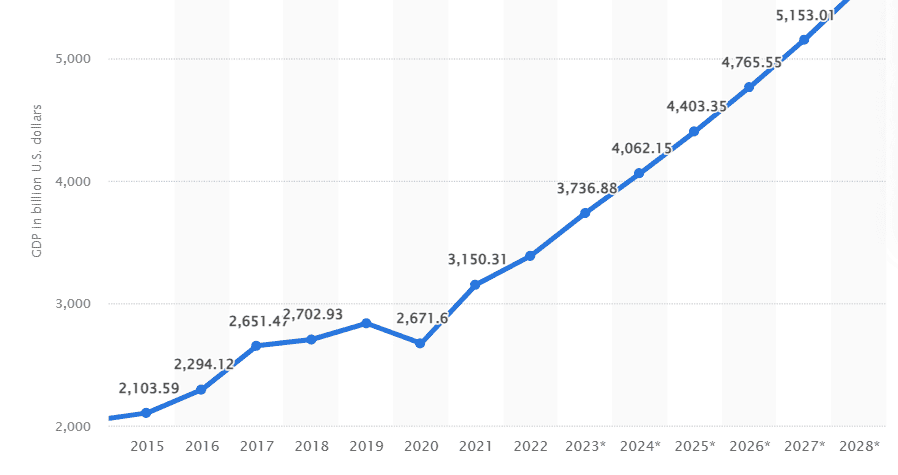
USA GDP 2013 to the second quarter of 2023

Data source: Statista

The Federal Reserve appears resolute in its commitment to combating inflation. Fed chair Jerome Powell recently stated that they will closely monitor data to guide their moves. Based on this assessment they will proceed cautiously in deciding whether to tighten policy by raising interest rates or wait for additional data.

However recent data indicates that the Fed may face pressure to tighten their policy even more. Haworth explains that softer employment figures are easing concerns among investors regarding rate hikes, by the Federal Reserve.

Impact on Investment Decisions

In the quarter earnings growth slowed down. Still exceeded expectations. This trend has continued into the quarter. Experts suggest that investors should pay attention to factors that have supported the economy despite the interest rate rise.

Although capital market performance has surpassed expectations so far in 2023 it was largely driven by technology stocks. Many other sectors of the market did not perform well in comparison. If there is growth in the coming months it could benefit other sectors of the market that are more reliant, on positive economic trends. The strength shown by the U.S. Stock market in July seems to be more widespread and not limited to a group of stocks.

Conclusion

In 2023 there is still a concern, about the possibility of a recession in the United States. According to research conducted by Goldman Sachs, there is an agreement that there is a 65% chance of an economic decline within the next year.

Crypto Market Trends and Forecasts for The Fall of 2023

Crypto Market Trends and Forecasts for The Fall of 2023

The cryptocurrency industry had its share of highs and lows in 2023. While Bitcoin and other popular cryptocurrencies had a good performance during the middle of the year, in the latter part of the year they either stayed stable or went down. In this article, we will understand the crypto market trends and forecasts for the fall of 2023.

A positive turn occurred in the Ripple court case with the U.S. Securities and Exchange Commission, which brought hope to investors. Additionally, the introduction of Worldcoin, a cryptocurrency that utilizes iris scans for user verification sparked conversations and debates. As the U.S. Government takes steps towards regulations for cryptocurrencies and with the Federal Reserve’s decisions on interest rates it seems that the upcoming fall will bring a phase, for the crypto market.

September’s Crypto Market Trends And Performance: A Closer Look

Bitcoins Journey in September:  In the month of June it touched the highest this year at the $30,466 mark. These gains were attributed to reports indicating a decrease in inflation rates. However now in almost mid-September Bitcoins momentum slowed down to the present mark of $25,752 mark (September 12, 2023)

bitcoin september 2023

Image source: Statista

Ethereum: Just like Bitcoin Ethereum also gained its high in April 2023 which was $1905. In September it was down to $1632.9

Ethereum:

Solanas Remains Stable: Among the ten cryptocurrencies based on market value, Solana remained stable in 2023. In March 2022 it reached a level of $204.35. In January 2023 it was around $23.96 and on September 7, 2023, the value was almost stable at $19.63.

Solanas Remains Stable

Overview of Market Capitalization: Taking a look back, at performances the global cryptocurrency market reached its peak in November 2021 with a capitalization exceeding $2.9 trillion.

Overview of Market Capitalization

However, the cryptocurrency industry experienced a setback during the winter of 2022. By the end of July, the market cap had decreased considerably to a $1.2 trillion.

The XRP Court Ruling:

On July 13 the crypto community witnessed a development when Ripple, the company, for the XRP cryptocurrency achieved a partial victory in its ongoing legal battle with the U.S. Securities and Exchange Commission (SEC). This legal dispute originated in 2020 when the SEC accused Ripple of violating securities regulations by selling XRP without registration. This had a strong impact on the crypto market trends that can change during the fall of 2023.

The recent ruling, delivered by a judge from the Southern District of New York clarified that XRP cannot be categorically classified as a security. This declaration had an impact on the value of XRP. Also influenced other alternative cryptocurrencies. However, it’s important to note that this ruling was nuanced and didn’t represent a triumph for Ripple.

While determining that sales of XRP through trading algorithms, exchanges, or employee compensation schemes did not meet the criteria for being considered securities there was an exception. The judge expressed their view that Ripple’s sale of XRP to institutions could indeed be categorized as securities transactions.

This ruling carried implications for major cryptocurrency exchanges. In response to the outcome for XRP, both Coinbase and Kraken swiftly reinstated XRP trading, on their platforms. Furthermore Coinbases stock price saw an uplift following the aftermath of the Ripple decision.

Investors were mainly optimistic because they saw the XRP ruling as an indication, for Coinbase. This gave them hope in Coinbase’s battle with the SEC, where it is accused of acting as an unregistered broker and exchange. However, it’s important to note that the court’s decision, on XRP didn’t entirely favor Ripple. It did bring some needed clarity to the world of cryptocurrency regulations and its impact was felt throughout the wider crypto community.

Worldcoin's Intriguing Launch: Potential and Pitfalls

Worldcoin’s Intriguing Launch: Potential and Pitfalls

An Innovative Approach to Digital Identity

In July the world of cryptocurrencies saw the arrival of a contender called Worldcoin. Led by Sam Altman, who’s well known for his role, in OpenAI, the birthplace of ChatGPT Worldcoin has introduced a method, for digital identification. By incorporating iris scanning technology Worldcoin aims to issue ” passports” called World IDs. This initiative aims to address the growing problem of distinguishing people from AI entities in interactions.

Concerns Over Security and Privacy

The Worldcoin initiative although innovative has not avoided criticism. The gathering of data the sensitive iris scans has raised concerns. Those who oppose cryptocurrency are worried, about the risks, to security and privacy that may result from storing sensitive information.

Trading, Distribution, and Market Reception

The Worldcoin token, known as WLD was introduced on July 24. To encourage adoption people who underwent an iris scan were given tokens. Although people, in the United States, cannot currently acquire WLD tokens Worldcoin has made its presence felt in cities like New York, San Francisco, and Miami.

These cities are among the 30 locations where individuals can participate in the Worldcoin eye experience. During its week of trading, WLD’s performance showed volatility with prices fluctuating between $1.66 and $3.58 according to CoinMarketCap data. Despite being in its stages Worldcoin already has a market capitalization of around $267 million.

Worldcoins entry into the cryptocurrency realm has been far from ordinary. With its approach to identity and some underlying concerns, it is generating considerable interest, within the crypto community.

Emerging Cryptocurrency Legislation: A Glimpse into the Future

In July there was a lot of activity, in the U.S. Congress regarding cryptocurrency. With the crypto industry growing investors and stakeholders have been eagerly waiting for guidelines on how it will be regulated.

The House Financial Services Committee (HFSC) took a step forward. They not only pushed forward a bill that focused on creating rules for payment stablecoins but also introduced another comprehensive bill. This detailed legislation aims to establish a framework for regulating cryptocurrency. One significant aspect is defining criteria to determine whether digital assets should be classified as securities or commodities.

At the time the Senate demonstrated its commitment to preventing the misuse of cryptocurrencies. A substantial defense spending bill was approved by the Senate. Included provisions that empower the Treasury Department to take action against using cryptocurrencies for illegal activities.

Overall July showed that U.S. Legislators are taking steps to shape the cryptocurrency industry while emphasizing the need, for innovation and responsible oversight.

Elon Musk’s Dogecoin Endeavors: More than Just a Meme?

In July there was a surge, in the popularity of Dogecoin, a cryptocurrency inspired by memes. This increase became particularly pronounced on July 24 when the value of this coin rose by 8%. The main catalyst behind this leap can be attributed to Elon Musk, the renowned tech mogul. As the CEO of Tesla and now leading the platform formerly known as Twitter but rebranded as “X ” Musk made a significant move by updating his bio on the platform to feature the symbol of Dogecoin.

The connection between Musk and Dogecoin runs deep. Not only has he previously allowed Dogecoin as a form of payment for Tesla merchandise but he also holds significant investments in this cryptocurrency.

Given Musk’s efforts to rebrand Twitter as “X,” there is speculation within the crypto community about the potential integration of Dogecoin as an officially recognized payment method, on this platform. Only time will reveal whether these speculations will become reality.

July To September Crypto Headlines: A Month of Revelations and Transformations

July witnessed an array of notable events in the cryptocurrency world. From corporate strategies to regulatory actions, the industry was abuzz with activity. Here’s a roundup:

MicroStrategy’s Future with Bitcoin

On July 26th TD Cowen issued a rating, for MicroStrategy (MSTR) a well-known company that has made significant investments in Bitcoin. Lance Vitanza, an analyst at TD Cowen expressed support for the company’s long-term strategy. Shared his perspective;


  • • The company’s decision to consistently invest its retained earnings in Bitcoin is not a short-term tactic.
  • • Bitcoin has the potential to surpass metals and fiat currencies as a store of value.
  • • MicroStrategy offers an opportunity for those in gaining exposure, to Bitcoin.

Binance’s Woes Continue

Binance, a leading cryptocurrency exchange, faced a rough patch:

  • The company terminated over 1,000 staff roles.
  • Benefits for the existing team were trimmed.
  • Regulatory challenges from the SEC and the Commodity Futures Trading Commission plagued Binance. These allegations pertain to Binance’s illicit U.S. operations. Consequently, Binance.US experienced a drastic fall in market share, plummeting from 27% in April 2023 to just above 1% in July.

CoinDesk’s Potential Acquisition

An investor consortium spearheaded by Tally Capital and Capital6 is on the brink of purchasing the crypto-centric media entity CoinDesk for a whopping $125 million. This acquisition seems promising, given CoinDesk’s robust 2023 revenue of $50 million sourced from various channels.

Celsius Network’s Downfall

July 13 marked a low point for Alex Mashinsky, Celsius Network’s originator. Arrested and slapped with multiple charges, including securities fraud and market manipulation, the collapse of Celsius is reminiscent of FTX’s demise in 2022’s crypto winter.

Bitcoin ETF Prospects

In the Bitcoin ETF arena, a recent study by NYDIG proposed a potential $30 billion spike in Bitcoin demand due to a Bitcoin spot exchange-traded fund. Despite the SEC’s reservations about investor protection, the crypto community remains hopeful. They anticipate that fresh Bitcoin ETF applications from giants like BlackRock and Fidelity might tilt the scales.

In summary, July was a dynamic month for the crypto universe, marked by highs and lows, painting a vivid picture of an industry in flux.

Final Words

As we head towards the autumn of 2023 the world of cryptocurrencies finds itself at a juncture where innovation and regulation intersect. As Bitcoin and other major digital currencies navigate through market fluctuations, changes, and technological advancements the future ahead appears both captivating and challenging.

From the outcome of the case involving Ripple to the introduction of projects, like Worldcoin along with ongoing efforts to establish clear regulations within the crypto realm this upcoming season holds great significance for developments.

As we observe how market dynamics interact with forces, those involved in the community eagerly await how these trends will shape the destiny of digital assets. The path ahead will undoubtedly be influenced by striking a balance, between innovation, responsible governance, and meeting the evolving needs of investors and enthusiasts who contribute to this vibrant ecosystem.

Frequently Asked Questions (FAQs)

  1. What were the major trends in the cryptocurrency market during the first half of 2023?

    The first half of 2023 saw significant fluctuations in the value of major cryptocurrencies, with Bitcoin and others hitting 52-week highs before facing a slowdown in the latter part of the period. Additionally, regulatory developments, such as the Ripple court ruling and the launch of Worldcoin, garnered substantial attention.

  2. How did the Ripple court ruling impact the crypto market?

    The Ripple court ruling offered a partial victory for the company in its legal battle with the U.S. SEC. The court’s determination that XRP isn’t necessarily a security on its face had implications for the classification of digital assets. This decision affected investor sentiment and contributed to market trends.

  3. What is the significance of Worldcoin’s launch and its controversy?

    Worldcoin’s launch introduced an innovative concept of using iris-scanning technology for digital identity verification. This raised both interest and concerns within the crypto community due to potential privacy and security risks associated with collecting biometric data.

  4. What can we anticipate for the cryptocurrency market in the coming fall of 2023?

    The fall of 2023 holds the promise of continued market volatility, further regulatory developments, and potential technological innovations. Cryptocurrency enthusiasts and investors are eager to witness how these factors will interact to shape the trajectory of digital assets in the months ahead.

Adyen

Adyen, a Stripe Rival, Reported its Slowest Revenue Growth Yet

In 2018 Adyen, a payment company confidently made its debut on the Amsterdam stock exchange swiftly emerging as a strong contender, against industry giants such as PayPal and Sripe. This remarkable ascent was further fueled by their expansion in North America catching the attention of merchants and prompting a significant recruitment drive to fuel their growth.

However, in 2023 they faced unexpected obstacles. The company experienced its lowest revenue growth ever recorded, resulting in a 39% decline in share value, within a single day. This sudden downturn wiped out a market value of 18 billion euros ($20 billion).

Investors were left stunned. The stock suffered another blow the day. The journey of Adyen serves as a reminder of how unpredictable the business world can be – even powerful entities can face challenges.

What is Ayden?

Adyen, a recognized name, among the 200 global fintech companies according to authorities like CNBC and Statista has rapidly become a major player in the payment services industry. With clients like Netflix, Meta, and Spotify their influence is undeniable. This positions them as leaders in financial technology.

What is Ayden?

Image source

However, Adyen offers more than payment processing capabilities. They distinguish themselves by acting as a payment gateway that utilizes cutting-edge technology to enable merchants to accept card payments both in physical stores.
Their extensive system, designed for the age seamlessly integrates shopping experiences with traditional in-store purchases. In return for its role in streamlining transactions, the company earns a percentage fee from every transaction processed through its platform.

The company’s success story can be attributed to its founders; Pieter van der Does serving as CEO and Arnout Schuijff formerly holding the role of Chief Technology Officer. Their shared vision and expertise have not revolutionized transaction processes for businesses. It has also solidified the company’s position as an influential player, within the ever-evolving fintech landscape.

Adyen’s Unexpected Slowdown

Adyen recently shared its results for the half of this year and the numbers presented were not exactly what the market expected. While the company revealed a revenue of 739.1 million euros showing a 21% increase compared to the year it also indicated Adyen’s sales growth since its records began.

Adyen's Unexpected Slowdown

Image source

This was quite different, from what analysts had predicted. According to Refinitiv Eikons forecasts they had estimated the revenue to be around 853.6 million euros, with a year-on-year growth of 40%.

A Shift in Market Dynamics

Since Adyen made an entrance, into the stock market in 2018 it has gained a reputation as a growth stock consistently demonstrating a surge in revenue every six months of about 26%. However recent changes in the market seem to be impacting this trajectory.

During an interview with CNBC’s “Squawk Box Europe ” Ethan Tandowsky, Adyen’s CFO shed some light on the situation. He discussed how rising inflation rates have led to increased interest rates resulting in a shift in their business focus from growth, to a more bottom-line-oriented approach.

Courtesy: CNBC

Tandowsky was quick to reassure that the company has experienced customer losses and highlighted that none of their clients have left.

Challenges and Future Prospects

However, Adyen has expressed concerns, about the landscape in North America. They believe that local competitors are approaching with cost solutions posing a potential threat to Adyen’s established position in the market. This competitive pressure is evident in Adyen’s shareholder letter, which mentioned a decrease in their EBITDA margin; from 59% in the half of the previous year to 43% during the same period in 2023.

The decline was attributed to growth in North America and increased employment costs due to their hiring strategy.

Despite these challenges, Tandowsky, a representative of the company remains hopeful about the value proposition that Adyen offers. He believes that while competitors may provide services at prices it is Adyen’s focus on “functionality” that sets them apart.

Tandowsky expressed confidence in Adyen’s ability to innovate and stated; “We have an approach to developing functionality that surpasses our competitors and this will help us gain the market share we anticipate.”

This statement highlights Adyen’s commitment not to compete based on price. Also by offering superior service. Only time will reveal if this strategy will guide the company back, toward its heyday of growth.

Adyen’s Core Dilemma: A Structural Overview

  • The Customer Dependence Challenge
    • Adyens recent challenges stem from its business model, which relies heavily on clients’ loyalty, to a platform for all their payment needs. This approach requires not only retaining customers but also ensuring that Adyen’s offerings outperform those of its competitors.
    • Given the uncertainties, such as rising interest rates and increasing inflation many of Adyen’s North American clients are reassessing costs and seeking optimized solutions. In their year 2023 report, the company acknowledged this trend pointing out that businesses are now prioritizing cost-effectiveness, over features.
  • The Pricing and Profitability Equation
    • Despite the changing landscape, the company has remained steadfast in its pricing strategy aiming to reflect the value it brings to the table. However this focus, on value has come with its drawbacks. Adyen’s commitment to recruitment efforts for example has impacted its profitability.
    • The company experienced a 10% decrease in EBITDA compared to the year’s half amounting to 320 million euros. In contrast, some of its competitors such, as Stripe took an approach by reducing their workforce by 14% in November 2022.
The Pricing and Profitability Equation
  • The Pricing and Profitability Equation
    • Despite the changing landscape, Adyen has remained steadfast in its pricing strategy aiming to reflect the value it brings to the table. However this focus, on value has come with its drawbacks. Adyen’s commitment to recruitment efforts for example has impacted its profitability.
    • The company experienced a 10% decrease in EBITDA compared to the year’s half amounting to 320 million euros. In contrast, some of its competitors such, as Stripe took an approach by reducing their workforce by 14% in November 2022.
  • Growing Competition and Market Dynamics
    • . Adyen faces more, than internal challenges. The broader market landscape brings its set of difficulties. One major hurdle is the rise of competitors who offer rates undercutting the company. Van der Does, the CEO of Adyen acknowledged this situation in a conversation, with the Financial Times. He mentioned how merchants are increasingly opting for providers to minimize costs.
    • While van der Does emphasized that Adyen is not shrinking but rather growing at a pace his statement highlights the company’s struggle in a market where price competitiveness is becoming increasingly important.
  • Adyen’s Unique Workforce Strategy
    • In the past, the company has been quite selective, in its hiring strategy preferring to have a team compared to its competitor, Stripe, which has almost double the number of employees.
    • This approach has its advantages and disadvantages. On one hand, it showcases Adyen’s efficiency. On the other hand, it brings up concerns, about the company’s ability to handle significant demands and competition.
  • The Future: What Lies Ahead?
    • Simon Taylor, a representative, from Sardine.ai provides a perspective indicating that Adyen may reach a point where it faces limitations in its growth potential and needs to reconsider its profit margins in order to continue expanding. He emphasizes that like any participant in the e-commerce industry, Adyen is not immune to the macroeconomic challenges.
    • However, he also reminds stakeholders that achieving a growth rate of 21% is something many professionals in the field would be envious of despite these obstacles.
    • In conclusion, while the company does face challenges within the ever-changing digital payments landscape it’s important to acknowledge its accomplishments and strategic decisions that have propelled it to its current position. Adapting to these shifts in structure while staying true to its core value proposition will play a role, in determining Adyen’s trajectory.

Conclusion

Adyen is currently facing a variety of challenges that make their situation complex. These challenges include relying on customers to make pricing decisions dealing with increased competition and managing changes, in their workforce. Although the company is doing a good job of providing value it can’t ignore the pressures it face particularly from competitors who offer lower costs.

New Fee By Amazon

Amazon Hitting Sellers with a New Fee

Amazon is like a big shop on the internet where many sellers sell their things. Recently, Amazon made a new rule where some sellers have to pay a new type of fee to Amazon. This is a big deal because many sellers might be affected by it and their profits might be jeopardized. Let us understand the new fee by Amazon and how it is going to affect the sellers.

Understanding the New Fee By Amazon

Starting from October 1st Amazon has implemented a modification in the fee structure for sellers. This change specifically impacts sellers who prefer to ship products directly to their customers without using Amazon’s delivery system or the company’s “fulfillment service”.

amazon seller's site

Image source

Under this policy for every item sold by these sellers, Amazon will now charge 2% of the item’s price. This policy falls under the “Seller Fulfilled Prime Program.” However, it is important to note that if the 2% fee amounts to less than $0.25 the seller will have to pay a minimum fee of $0.25 to Amazon.

This updated rule signifies that regardless of the product’s cost Amazon will consistently receive a portion from each sale if sellers use their individual shipping methods. Sellers will now have to think of strategies that can help them to save their profit margins. Especially those sellers who sell low-cost products will have to either increase their costs on Amazon stores or will have to face a loss of 2%.

Seller Fulfilled Prime Program

The Birth of the Program

In 2015 Amazon launched an initiative called the Seller Fulfilled Prime program which generated excitement, among sellers. This program offered them the opportunity to display the ‘Prime’ badge on their products. The presence of this badge is highly sought after by buyers as it typically signifies faster delivery.

Seller Fulfilled Prime Program

What’s even better is that sellers were not required to utilize Amazon’s Fulfillment – Amazon’s own delivery system in order to qualify for this badge. This helped small businesses to get highlighted and improve their sale and reputation on Amazon.

The Prime Promise

However, there was a catch. In order to display the Prime badge on their products sellers were required to make a commitment. They had to ensure delivery of their products super fast within one or two days to Prime customers. Sellers had no option but to charge any fees for this expedited shipping service. It had to be included as part of the agreement.

A Pause and a Restart

Sometimes there were hiccups, along the way. Amazon became aware of many instances where deliveries didn’t meet their expected level of speed and quality.

As a result, they temporarily suspended sellers from joining the program to ensure that customers consistently received top-notch services. However, in a turn of events for sellers, Amazon made the decision to welcome new sellers back, into the program. This means that more sellers now have the opportunity to display the Prime badge if they commit to delivering.

The Underlying Reasons for the New Fee By Amazon

Every major company, including giants like Amazon, often has underlying motivations behind their decisions. At its core, every change, tweak, or new rule is strategized to enhance the company’s growth or sustainability. Understanding the rationale behind Amazon’s decision to impose a new fee requires a dive into its business objectives.

Profitability at the Helm

Profit is more than a goal for Amazon; it is a driving force. Shipping as a part of their service can be quite expensive. The expenses involved in maintaining truck fleets, ensuring deliveries on time, and employing thousands of people to manage the process quickly add up to the cost.

Amazon revenue chart

Data Source: Statista

From a business perspective, it’s not smart but crucial for long-term profitability to find a strategy that offsets or recoups some of these costs. This is where the new fee comes into play. By charging sellers, especially those in the Seller Fulfilled Prime program Amazon aims to create a revenue stream that helps balance out the shipping costs.

Diversified Ventures and Continuous Revenue

Apart from its core e-commerce model, Amazon has branched out into several other sectors. Prime Video is one such venture, where Amazon spends a considerable amount annually to produce or acquire content. This is to ensure that they remain competitive in the streaming wars. Such ventures, while promising returns in the future, require consistent funding and innovation.

And where does this fund come from? New revenue streams is the answer. And the new fee by Amazon is one such source of revenue.

Treading Carefully with Sellers

There is no doubt that sellers form the backbone of Amazon’s vast marketplace. The more sellers sell on Amazon, the more profit Amazon earns. And more sellers also add to the vast variety of products that we see on Amazon. The new fee by Amazon might not be a welcomed step by sellers.

This is where Amazon treads on thin ice. Sellers selling low-cost items might struggle to keep their profit margins. For example, if you are a seller selling a $1.99 product with a profit margin of $0.50, you will lose $0.25 to the new fee by Amazon. (See the example of the real product – Wall Decor)

image 22

Image source

So what does a seller do in such a condition? They either leave selling on Amazon or increase the price. So let us discuss how sellers will be affected by this new fee.

Impact on Amazon’s Backbone: The Sellers

Below are some possible impacts on the sellers due to the new fee by Amazon.

Financial Strain on Sellers: First and foremost, sellers will have to deal with an additional cost for their business as mentioned earlier. This new fee might seem small at 2% or a minimum of $0.25 per item, but for sellers who sell low-cost items, this is devastating. Even for high-volume sellers, this can quickly add up. Behind every product sold, there are various costs that a seller pays. Cost for buying raw material, storing, marketing, and then delivery- the seller pays it all.

Potential Increase in Product Prices: The only option that remains with the seller is to increase the price. To cope with the added costs, sellers might be forced to increase their product prices. By passing on the extra cost to consumers, sellers can maintain their profit margins. Or they might compromise with the quality of the product to sustain.

Brand Loyalty: There are many sellers who have been associated with Amazon for a long period of time. They are loyal to the brand. But, the new fee by Amazon can push them to find out ways to sell their products. Their brand loyalty to Amazon is at stake.

The Larger Picture: Amazon Vs. Shopify

amazon vs shopify

E-commerce is not a one-player game. While Amazon was a forerunner in the U.S., Shopify emerged as a formidable contender. Shopify offers an easy-to-use online shopping system that can be tailored to individual needs.

Shopify revenue chart

Initially, their customers were of different types. One type that preferred Amazon found the interface easy to post and sell products by creating their own store. They were attracted to the huge user base that Amazon had. On the other hand, the other type of customer who wanted to avoid competition and freedom to sell their products on their own terms preferred Shopify. But, now in 2023, things have changed. People want to sell their products anywhere and everywhere.

In such a scenario, Shopify will get an edge over Amazon and sellers will prefer to sell the products on their own instead of depending on Amazon. Amazon’s new fee can serve as a pivot point.

Frequently Asked Questions (FAQs)

  1. What is Amazon’s new fee for third-party sellers?

    Starting October 1, Amazon will levy a 2% fee, or a minimum of $0.25 per item, for all the sellers who ship their products directly to the customers.

  2. Who will be affected by this new fee?

    Merchants who are part of the Seller Fulfilled Prime Program will be affected.

  3. Why has Amazon introduced this new fee?

    While Amazon hasn’t provided a detailed rationale, it’s evident that business profitability is a driving factor. Shipping is a significant expense for the company, and this fee might help counterbalance some of those costs.

  4. What is the Seller Fulfilled Prime Program?

    This allows merchants to show the ‘Prime’ logo on their listings without using Amazon’s Fulfillment by Amazon service. In exchange, retailers must provide Prime members with free one-day or two-day delivery.

  5. Will this fee affect product prices on Amazon?

    Yes. Where the profit margin is low the seller will compensate the loss by increasing the price.

  6. Are there alternatives to selling on Amazon for merchants?

    Yes. Sellers can use Shopify or other niche-based stores to sell their products.

Health And Beauty Retail Trends

Retail Trends Indicate Health and Beauty Spending Moving Online

Every day individuals, from all corners of the world stand in front of mirrors experimenting with makeup styles rejuvenating their skin or fashioning their hair. It’s not about appearing appealing and attractive, it’s also about feeling self assured and taking care of oneself. And these defining factors are going to set the health and beauty retail trends in 2026 and beyond.

With the expanding influence of the internet and social media these daily routines are undergoing a digital transformation and further influencing the health and beauty retail trends all across the world. An increasing number of shoppers are opting to browse and purchase online than visiting brick and mortar stores.

The online market is abuzz with brands that deliver beauty and personal care products right to your doorstep. With cutting edge technology enabling “try on” products and personalized options tailored specifically for you, shopping has never been more convenient. The future of health and beauty shopping is here to stay for long.

Pioneers eCommerce Stores Setting The Health And Beauty Retail Trends in Health and Beauty

The eCommerce landscape has forever altered the way how consumers shop for beauty and personal care items. From niche brands to global players competition is both extensive and intense, within this industry. Nevertheless amid this environment, a handful of giants have emerged as leaders who not only dominate in terms of revenue but also drive innovation and engage consumers effectively. They are the biggest influencer and health and beauty retail trends setters.

top online stores

Data source: Statista

Sephora

Sephora is a beauty retailer known worldwide for its collection of beauty products and its dedication to providing a one of a kind shopping experience. With its origins, in France in 1969 Sephora has expanded globally becoming a destination for beauty enthusiasts.

Sephora

Image source

What sets Sephora apart is the range of cosmetics skincare items, fragrances and haircare products it offers including luxury and high end brands. Sephora’s stores are designed to be immersive and interactive allowing customers to freely explore and try out products.

This focus on the in store experience, combined with the expertise of their staff members has made Sephora a popular choice for beauty education. Customers can receive recommendations and expert advice on skincare routines and makeup application techniques.

Furthermore Sephora has played a leading role in promoting inclusivity and diversity within the beauty industry. The retailer actively seeks out brands that cater to diverse skin tones and types to ensure that everyone can find products that suit their needs.

This commitment to diversity is evident in Sephora’s advertising campaigns as their, in store displays which prominently feature a diverse range of models and products. Sephora’s innovative marketing and promotion tactics has helped set various health and beauty retail trends in the US.

Moreover Sephora also provides its range of products, under the brand name Sephora Collection. This collection is widely recognized for its quality and reasonable prices allowing a wider audience to enjoy beauty products. Sephora’s commitment to innovation, inclusivity and customer satisfaction has firmly established it as a leading player, in the beauty sector influencing the beauty industry on a significant scale.

Ulta Beauty

Ulta Beauty, commonly known as Ulta is a known beauty and cosmetics chain that has gained popularity across households, in the beauty industry. Established in 1990 Ulta has expanded to become one of the most successful beauty retailers in the United States. The brand is renowned for its range of beauty products offering everything from skincare and haircare to makeup and fragrances.

Ulta Beauty

Image source

What makes Ulta unique is its ability to bring together both end and affordable beauty brands all under one roof catering to a range of customers with different preferences and budgets. This inclusive approach has made Ulta a preferred destination for beauty enthusiasts from backgrounds ensuring that everyone can access top quality products while enjoying a shopping experience.

In addition to its product selection Ulta is also known for its in store and beauty services. Many Ulta stores feature salons that provide a variety of beauty treatments such as haircuts, styling and spa services. This allows customers to find all their beauty needs in one place.

The brands commitment to inclusivity is further demonstrated through its marketing campaigns showcasing diversity. By offering a range of products suitable, for all skin tones and types.

Ulta Beauty has not just transformed the way people purchase beauty products. It has also made an impact, in encouraging self expression and boosting confidence through makeup and skincare. This has established Ulta Beauty as an influential brand, within the beauty industry in the US.

Bath & Body Works

Bath & Body Works

Image source

Bath & Body Works is a known retail company that specializes in offering a wide range of personal care and home fragrance products. It was established in 1990 in New Albany, Ohio. Has since become synonymous, with quality and luxury in the realm of self care.

The brand is famous for its selection of body care items, including lotions, shower gels and body mists available in an array of captivating fragrances. Bath & Body Works has perfected the art of creating scents that evoke emotions and moods making it a go to destination for those looking to indulge themselves or find the perfect gift.

What makes Bath & Body Works stand out is its dedication to providing customers with a shopping experience. Their stores are designed to captivate customers with displays and the chance to try out products before making a purchase. The brand also excels at offering limited time collections and seasonal scents to keep their product lineup fresh and exciting.

In addition to personal care items Bath & Body Works has expanded its range to include home fragrance products, like candles and room sprays adding a touch of comfort and luxury to customers daily lives.
Bath & Body Works has become a brand, in the care and home fragrance industry because of its commitment, to delivering high quality products fostering innovation and providing customers with a delightful multisensory experience

The Changing Landscape of Online Beauty Shopping: Key Trends to Keep an Eye On

The beauty and personal care industry has witnessed a surge, in shoppers in times. As consumers become tech savvy and e commerce platforms become increasingly user friendly there has been a shift in shopping preferences. While beauty and self care routines differ across the globe some interesting trends shed light on the evolving mindset of todays beauty shoppers.

Revenue of the e-commerce beauty care market (in billion U.S. dollars)

online market revenue

Health and Beauty Retail Trends – Exponential Growth In Online Shopping

  • Embracing the Digital Era: Directing The Health And Beauty Retail Trends in 2026: In the years many people have been drawn to the convenience of online shopping with approximately 30% of global consumers opting for digital channels for their beauty and personal care needs. The appeal of shopping from the comfort of ones home combined with the array of products available online has significantly influenced this change.
  • Spending Patterns; The Online Beauty Cart: Delving into spending habits on average global beauty shoppers spend, around two U.S. Dollars each time they shop online. While this amount may seem modest initially considering the frequency of purchases and the large number of shoppers it adds up to a sum.
  • Impulsive Shopping; Examining Gender Differences: The thrill of stumbling upon a product or catching sight of a limited time offer can often tempt individuals into making purchases. 30% of women have openly admitted to giving in to buying when it comes to personal care products. In contrast men appear to exercise restraint with, under 20% succumbing to the allure of impulse purchases. These statistics shed light on the contrasting shopping behaviors and decision making processes between female consumers.

Popular Beauty Product Searches

  • Calamine Lotion: A Global Favorite: Emerging as a frontrunner in beauty searches for 2022 calamine lotion has captured the attention of consumers worldwide. Renowned for its soothing properties for skin it is evident that individuals globally sought comfort and relief possibly due to changes in their environment, lifestyle shifts or heightened stress levels.
  • Coconut Oil; The Versatile Ingredient Taking Center Stage: For years coconut oil has been held in regard for its advantages spanning skincare, haircare and even dietary applications. Its popularity skyrocketed in 2022 as it garnered the online search traffic worldwide. Undoubtedly this ingredients versatility and natural properties have played a role in its acclaim.
  • Vitamin C Serums: The Pursuit of Radiance: One trend worth mentioning is the growing interest surrounding top quality vitamin C serums. Consumers are increasingly curious, about finding the serums enriched with vitamin C for achieving radiant skin. These skincare serums, known for their ability to brighten the skin and reduce signs of aging have become a must have, in peoples skincare routines. The increase in searches indicates a desire to achieve radiant skin.

Top 30 Keywords Searched In Beauty Segment

Top 30 Keywords Searched In Beauty Segment

The beauty and personal care industry is constantly evolving, with the influence of advancements. As consumers around the world adapt and change their habits, preferences and curiosities provide insights into the future of beauty shopping. Brands and retailers that stay attuned to these trends and continuously adapt are positioned for success in this changing landscape.

Key Areas to Watch for Transformative Growth in the Beauty Industry

The beauty sector has always been a hub of innovation and change. It will continue to be in the coming years. Driven by evolving consumer behaviors and market dynamics there are categories within the beauty industry that are expected to experience growth. Lets take a look at four segments that will shape the future.

  • The Rise of Premium Beauty
    As consumers increasingly seek high quality products there will be a surge in demand, for premium beauty items. The natural beauty segment is the one that is growing the most. These health and beauty retail trends are expected to propel the beauty category of mass market products in the coming years.
    Between the years 2022 and 2027 it is expected that the premium beauty segment will experience a growth rate of 8% annually which stands out in contrast, to the projected 5% growth in beauty products. Fragrances and makeup are areas where consumers are likely to increase their spending.
  • Indie Brands Rising
    The beauty industry has witnessed the emergence of brands over the past decade. These brands have successfully captured market attention. Are now ready to expand their operations. This increased competition will drive both established and budding brands to innovate. According to McKinseys survey in 2023 42% of consumers express their interest in exploring brands indicating a significant opportunity for these indie brands to thrive.
  • Evolution of Ecommerce:
    The e commerce sector in the beauty industry has experienced growth expanding four times between 2015 and 2022. Currently more than 20% of beauty sales occur online. eCommerce is the key factor that will effect the health and beauty retail trends in near future. This growth can be attributed to factors;
    • The dominance of giants like Amazon and Tmall.
    • The increasing digital expertise among to consumer brands.
    • The growing importance of platforms, for omnichannel retailers
    • The use of social selling methods, including streaming is, on the rise in Asian markets.
    • Between 2022 and 2027 ecommerce is expected to continue its growth as the sales channel with an annual growth rate of 12%.
  • Traditional Channels Making a Comeback
    Embracing Both Online and Offline: Finding a Balance in Health And Beauty Retail Trends
    Despite the expansion of e commerce traditional sales channels are not fading away completely. Sectors like specialty retail, grocery retail and drugstores are predicted to experience a resurgence pandemic. This renewed interest stems from consumers preference for omnichannel shopping experiences that allow them to explore and try products in stores. However department stores might face challenges as they are expected to witness a decline in their market share.
  • Natural Beauty ProductsThe Present Ongoing Health And Beauty Retail Trends Setter
    The popularity of beauty products is growing rapidly as consumers increasingly prioritize their health and the environment when it comes to their skincare and cosmetics. In todays world being transparent, about ingredients. Being conscious of what we put on our bodiess extremely important. Natural beauty products have gained traction because they use plant based ingredients and avoid chemicals and synthetic additives.
    Consumers are becoming more selective looking for products that align with their values of sustainability, cruelty practices and overall well being. As people become more aware of the risks associated with beauty products there is a surge in demand for natural alternatives. This has led to innovation and growth in the beauty industry. This trend not reflects a cultural shift towards healthier lifestyles but also shows a commitment, to preserving our planets resources and promoting clean eco friendly beauty solutions.
  • AI Influence On Health And Beauty Retail Trends:
    The beauty and health industry has experienced a transformation, with the advent of intelligence (AI). This technology has brought about data driven solutions revolutionizing aspects. From virtual makeup try ons and skincare diagnostics to tailored wellness recommendations AI powered tools are being utilized effectively. By analyzing datasets machine learning algorithms can identify patterns and trends enabling beauty brands to create customized products that cater to skin types and concerns. In the healthcare sector AI plays a role in disease detection, drug discovery and optimizing patient care. Telemedicine platforms are leveraging AI driven chatbots and virtual assistants to enhance interactions and streamline healthcare services. The incorporation of AI not enhances the quality of products and services. Also empowers consumers by providing them with greater knowledge and control, over their beauty routines and overall well being. Ultimately this integration drives innovation and efficiency in these industries.

The beauty industry is on the brink of transformation. Whether its the growing demand, for premium products the increasing influence of indie brands the booming e commerce sector or the revival of shopping avenues – this sector is poised for changes. Brands that can adapt and cater to these evolving trends will undoubtedly lead the phase of beauty industry growth.

Innovative Strategies

The world of health and beauty business is constantly changing, with shifts in the way things are structured and the way competition works. For companies and industries navigating this evolving terrain means reevaluating strategies understanding emerging trends and being adaptable. These innovative strategies will also play a major role in setting the health and beauty retail trends. Here are some important retail trends in beauty and health industry to watch

Try-On Options

image 3
  • The Importance of Making Strategic Decisions:
    Deciding where to focus your efforts is the main goal for different retail businesses. The segment is vast and companies are planning to conquer the market niche by niche. . It’s not about excelling it’s also about finding the right position. With changing factors that drive growth the effective strategies used by businesses worldwide are now being scrutinized. The approach of using a one size fits all strategy that worked for many in the past is now less impactful. This calls for a reassessment of business plans with an emphasis on personalization and specificity.
  • The Search for Diversification Across Regions:
    In the past beauty industry could streamline their strategies, around two major markets; China and the United States. These countries with their consumer bases and thriving economies presented opportunities. However looking ahead into the landscape suggests a nuanced approach.
    By 2027 it is projected that Chinas beauty market will skyrocket to a $96 billion while North America follows closely behind with an estimated market value of $114 billion.
    While these numbers confirm the significance of these markets they also suggest the potential, for growth in regions. It would be shortsighted to rely on China and the U.S. As a strategy, brands should now explore markets to understand the characteristics of each region and expand their presence accordingly. This approach not only protects against market downturns in any particular region but also taps into the possibilities offered by emerging markets.
  • Tailored Strategies for Diverse Markets: Adapting to Regional Differences And Setting Region Based Health And Beauty Retail Trends
    The future will favor brands that can recognize preferences adapt to cultures and customize their offerings accordingly. This goes beyond superficial localization efforts; it requires an understanding of consumer behavior, regional trends and local competitors. The key to success lies in blending brand appeal with sensibilities.

As market dynamics continue to evolve, brands that remain stagnant and unchanged are becoming obsolete. The new business landscape demands flexibility, an understanding of local health and beauty retail trends and a willingness to adapt and change course when necessary. In this environment success belongs to those who can diversify their strategies while tailoring them to markets.

Asia and North America: The Regions That Will Affect The Health And Beauty Retail Trends In The Future

Their enormous market sizes have made them the main focus of strategies, for beauty brands. However as the industry continues to evolve what can we expect for these regions? What challenges and opportunities lie ahead?

The Battle of Titans: Growth in the Face of Challenges

While both Asia and North America hold potential it is becoming increasingly difficult for individual brands to achieve growth. The primary hurdle is the intensified competition with international brands competing fiercely for market share. Brands can no longer rely on their reputation; they must also possess a deep understanding of regional preferences and nuances in order to stand out in these crowded markets.

Emerging Markets: New Horizons in Beauty

As Asia and North America continue to dominate other regions are emerging as players in the beauty industry. The Middle East, with its beauty preferences and affinity for luxury presents a profitable market for brands willing to customize their offerings accordingly. At the time India’s vast population and increasing purchasing power make it poised to become a hub for beauty products particularly within specific categories and price segments. Brands that can adapt effectively to these emerging markets will discover avenues, for growth.

The Allure of Luxury: Exploring the Lucrative Premium Markets

While the wider beauty industry encounters challenges there is one sector that shines in terms of its growth prospects. And this is the ultraluxury beauty market. Currently valued at, around $20 billion experts predict that ultraluxury beauty market segment could skyrocket to $40 billion by 2027.

The demand for luxury and ultraluxury products in regions like Asia, with its customer base offers a remarkable opportunity. Brands that can cater to this segment by providing top notch quality, exclusivity and a touch of opulence will position themselves at the forefront of this profitable market.

Asia and North America will continue to play a role, in the beauty industry but the changing dynamics of competition and the emergence of new markets call for a more nuanced approach. Brands need to not identify regions with growth potential but also understand market segments like the luxury category, which offer significant opportunities for exponential growth. The future of the beauty industry is both challenging and full of possibilities waiting for those who’re willing to adapt and innovate.

Conclusion

Looking at the evolving landscape of health and beauty industry and retail rends, it’s evident that the health and beauty sectors are embracing a focused future based on innovation and new avenues to attract customers.

With consumers prioritizing convenience and personalized experiences online platforms are becoming their choice for self care and beauty needs. While physical stores still have their importance there is a shift, towards e commerce as it aligns with consumer behavior.

Brands that can seamlessly transition into this era by understanding and catering to shoppers desires will undoubtedly lead the next phase of health and beauty retailing.

The Changing Landscape of Online Beauty Shopping: Key Trends to Keep an Eye On

The beauty and personal care industry has witnessed a surge, in shoppers in times. As consumers become tech savvy and e commerce platforms become increasingly user friendly there has been a shift in shopping preferences. While beauty and self care routines differ across the globe some interesting trends shed light on the evolving mindset of todays beauty shoppers.

Revenue of the e-commerce beauty care market (in billion U.S. dollars)

online market revenue

Health and Beauty Retail Trends – Exponential Growth In Online Shopping

  • Embracing the Digital Era: Directing The Health And Beauty Retail Trends in 2026: In the years many people have been drawn to the convenience of online shopping with approximately 30% of global consumers opting for digital channels for their beauty and personal care needs. The appeal of shopping from the comfort of ones home combined with the array of products available online has significantly influenced this change.
  • Spending Patterns; The Online Beauty Cart: Delving into spending habits on average global beauty shoppers spend, around two U.S. Dollars each time they shop online. While this amount may seem modest initially considering the frequency of purchases and the large number of shoppers it adds up to a sum.
  • Impulsive Shopping; Examining Gender Differences: The thrill of stumbling upon a product or catching sight of a limited time offer can often tempt individuals into making purchases. 30% of women have openly admitted to giving in to buying when it comes to personal care products. In contrast men appear to exercise restraint with, under 20% succumbing to the allure of impulse purchases. These statistics shed light on the contrasting shopping behaviors and decision making processes between female consumers.

Popular Beauty Product Searches

  • Calamine Lotion: A Global Favorite: Emerging as a frontrunner in beauty searches for 2022 calamine lotion has captured the attention of consumers worldwide. Renowned for its soothing properties for skin it is evident that individuals globally sought comfort and relief possibly due to changes in their environment, lifestyle shifts or heightened stress levels.
  • Coconut Oil; The Versatile Ingredient Taking Center Stage: For years coconut oil has been held in regard for its advantages spanning skincare, haircare and even dietary applications. Its popularity skyrocketed in 2022 as it garnered the online search traffic worldwide. Undoubtedly this ingredients versatility and natural properties have played a role in its acclaim.
  • Vitamin C Serums: The Pursuit of Radiance: One trend worth mentioning is the growing interest surrounding top quality vitamin C serums. Consumers are increasingly curious, about finding the serums enriched with vitamin C for achieving radiant skin. These skincare serums, known for their ability to brighten the skin and reduce signs of aging have become a must have, in peoples skincare routines. The increase in searches indicates a desire to achieve radiant skin.

Top 30 Keywords Searched In Beauty Segment

Top 30 Keywords Searched In Beauty Segment

The beauty and personal care industry is constantly evolving, with the influence of advancements. As consumers around the world adapt and change their habits, preferences and curiosities provide insights into the future of beauty shopping. Brands and retailers that stay attuned to these trends and continuously adapt are positioned for success in this changing landscape.

Key Areas to Watch for Transformative Growth in the Beauty Industry

The beauty sector has always been a hub of innovation and change. It will continue to be in the coming years. Driven by evolving consumer behaviors and market dynamics there are categories within the beauty industry that are expected to experience growth. Lets take a look at four segments that will shape the future.

  • The Rise of Premium Beauty
    As consumers increasingly seek high quality products there will be a surge in demand, for premium beauty items. The natural beauty segment is the one that is growing the most. These health and beauty retail trends are expected to propel the beauty category of mass market products in the coming years.
    Between the years 2022 and 2027 it is expected that the premium beauty segment will experience a growth rate of 8% annually which stands out in contrast, to the projected 5% growth in beauty products. Fragrances and makeup are areas where consumers are likely to increase their spending.
  • Indie Brands Rising
    The beauty industry has witnessed the emergence of brands over the past decade. These brands have successfully captured market attention. Are now ready to expand their operations. This increased competition will drive both established and budding brands to innovate. According to McKinseys survey in 2023 42% of consumers express their interest in exploring brands indicating a significant opportunity for these indie brands to thrive.
  • Evolution of Ecommerce:
    The e commerce sector in the beauty industry has experienced growth expanding four times between 2015 and 2022. Currently more than 20% of beauty sales occur online. eCommerce is the key factor that will effect the health and beauty retail trends in near future. This growth can be attributed to factors;
    • The dominance of giants like Amazon and Tmall.
    • The increasing digital expertise among to consumer brands.
    • The growing importance of platforms, for omnichannel retailers
    • The use of social selling methods, including streaming is, on the rise in Asian markets.
    • Between 2022 and 2027 ecommerce is expected to continue its growth as the sales channel with an annual growth rate of 12%.
  • Traditional Channels Making a Comeback
    Embracing Both Online and Offline: Finding a Balance in Health And Beauty Retail Trends
    Despite the expansion of e commerce traditional sales channels are not fading away completely. Sectors like specialty retail, grocery retail and drugstores are predicted to experience a resurgence pandemic. This renewed interest stems from consumers preference for omnichannel shopping experiences that allow them to explore and try products in stores. However department stores might face challenges as they are expected to witness a decline in their market share.
  • Natural Beauty ProductsThe Present Ongoing Health And Beauty Retail Trends Setter
    The popularity of beauty products is growing rapidly as consumers increasingly prioritize their health and the environment when it comes to their skincare and cosmetics. In todays world being transparent, about ingredients. Being conscious of what we put on our bodiess extremely important. Natural beauty products have gained traction because they use plant based ingredients and avoid chemicals and synthetic additives.
    Consumers are becoming more selective looking for products that align with their values of sustainability, cruelty practices and overall well being. As people become more aware of the risks associated with beauty products there is a surge in demand for natural alternatives. This has led to innovation and growth in the beauty industry. This trend not reflects a cultural shift towards healthier lifestyles but also shows a commitment, to preserving our planets resources and promoting clean eco friendly beauty solutions.
  • AI Influence On Health And Beauty Retail Trends:
    The beauty and health industry has experienced a transformation, with the advent of intelligence (AI). This technology has brought about data driven solutions revolutionizing aspects. From virtual makeup try ons and skincare diagnostics to tailored wellness recommendations AI powered tools are being utilized effectively. By analyzing datasets machine learning algorithms can identify patterns and trends enabling beauty brands to create customized products that cater to skin types and concerns. In the healthcare sector AI plays a role in disease detection, drug discovery and optimizing patient care. Telemedicine platforms are leveraging AI driven chatbots and virtual assistants to enhance interactions and streamline healthcare services. The incorporation of AI not enhances the quality of products and services. Also empowers consumers by providing them with greater knowledge and control, over their beauty routines and overall well being. Ultimately this integration drives innovation and efficiency in these industries.

The beauty industry is on the brink of transformation. Whether its the growing demand, for premium products the increasing influence of indie brands the booming e commerce sector or the revival of shopping avenues – this sector is poised for changes. Brands that can adapt and cater to these evolving trends will undoubtedly lead the phase of beauty industry growth.

Innovative Strategies

The world of health and beauty business is constantly changing, with shifts in the way things are structured and the way competition works. For companies and industries navigating this evolving terrain means reevaluating strategies understanding emerging trends and being adaptable. These innovative strategies will also play a major role in setting the health and beauty retail trends. Here are some important retail trends in beauty and health industry to watch

Try-On Options

image 3
  • The Importance of Making Strategic Decisions:
    Deciding where to focus your efforts is the main goal for different retail businesses. The segment is vast and companies are planning to conquer the market niche by niche. . It’s not about excelling it’s also about finding the right position. With changing factors that drive growth the effective strategies used by businesses worldwide are now being scrutinized. The approach of using a one size fits all strategy that worked for many in the past is now less impactful. This calls for a reassessment of business plans with an emphasis on personalization and specificity.
  • The Search for Diversification Across Regions:
    In the past beauty industry could streamline their strategies, around two major markets; China and the United States. These countries with their consumer bases and thriving economies presented opportunities. However looking ahead into the landscape suggests a nuanced approach.
    By 2027 it is projected that Chinas beauty market will skyrocket to a $96 billion while North America follows closely behind with an estimated market value of $114 billion.
    While these numbers confirm the significance of these markets they also suggest the potential, for growth in regions. It would be shortsighted to rely on China and the U.S. As a strategy, brands should now explore markets to understand the characteristics of each region and expand their presence accordingly. This approach not only protects against market downturns in any particular region but also taps into the possibilities offered by emerging markets.
  • Tailored Strategies for Diverse Markets: Adapting to Regional Differences And Setting Region Based Health And Beauty Retail Trends
    The future will favor brands that can recognize preferences adapt to cultures and customize their offerings accordingly. This goes beyond superficial localization efforts; it requires an understanding of consumer behavior, regional trends and local competitors. The key to success lies in blending brand appeal with sensibilities.

As market dynamics continue to evolve, brands that remain stagnant and unchanged are becoming obsolete. The new business landscape demands flexibility, an understanding of local health and beauty retail trends and a willingness to adapt and change course when necessary. In this environment success belongs to those who can diversify their strategies while tailoring them to markets.

Asia and North America: The Regions That Will Affect The Health And Beauty Retail Trends In The Future

Their enormous market sizes have made them the main focus of strategies, for beauty brands. However as the industry continues to evolve what can we expect for these regions? What challenges and opportunities lie ahead?

The Battle of Titans: Growth in the Face of Challenges

While both Asia and North America hold potential it is becoming increasingly difficult for individual brands to achieve growth. The primary hurdle is the intensified competition with international brands competing fiercely for market share. Brands can no longer rely on their reputation; they must also possess a deep understanding of regional preferences and nuances in order to stand out in these crowded markets.

Emerging Markets: New Horizons in Beauty

As Asia and North America continue to dominate other regions are emerging as players in the beauty industry. The Middle East, with its beauty preferences and affinity for luxury presents a profitable market for brands willing to customize their offerings accordingly. At the time India’s vast population and increasing purchasing power make it poised to become a hub for beauty products particularly within specific categories and price segments. Brands that can adapt effectively to these emerging markets will discover avenues, for growth.

The Allure of Luxury: Exploring the Lucrative Premium Markets

While the wider beauty industry encounters challenges there is one sector that shines in terms of its growth prospects. And this is the ultraluxury beauty market. Currently valued at, around $20 billion experts predict that ultraluxury beauty market segment could skyrocket to $40 billion by 2027.

The demand for luxury and ultraluxury products in regions like Asia, with its customer base offers a remarkable opportunity. Brands that can cater to this segment by providing top notch quality, exclusivity and a touch of opulence will position themselves at the forefront of this profitable market.

Asia and North America will continue to play a role, in the beauty industry but the changing dynamics of competition and the emergence of new markets call for a more nuanced approach. Brands need to not identify regions with growth potential but also understand market segments like the luxury category, which offer significant opportunities for exponential growth. The future of the beauty industry is both challenging and full of possibilities waiting for those who’re willing to adapt and innovate.

Conclusion

Looking at the evolving landscape of health and beauty industry and retail rends, it’s evident that the health and beauty sectors are embracing a focused future based on innovation and new avenues to attract customers.

With consumers prioritizing convenience and personalized experiences online platforms are becoming their choice for self care and beauty needs. While physical stores still have their importance there is a shift, towards e commerce as it aligns with consumer behavior.

Brands that can seamlessly transition into this era by understanding and catering to shoppers desires will undoubtedly lead the next phase of health and beauty retailing.

Frequently Asked Questions

  1. Why is there a shift in health and beauty spending moving online?

    The change can be credited to a range of reasons, including customer convenience, wider array of products to choose from, customized experiences and advancements in technology that allow for virtual product trials.

  2. Are brick-and-mortar beauty stores becoming obsolete?

    While there’s a noticeable increase in online spending, brick-and-mortar stores remain relevant, especially for consumers who prefer in-store product trials and immediate purchases.

  3. Which countries lead in online beauty and health spending?

    The United States and China are among the top countries when it comes to online health and beauty spending, with platforms like Sephora and Alibaba driving significant sales.

  4. How reliable is online shopping for beauty products?

    The reliability of online shopping largely depends on the platform and brand. Most reputable platforms have stringent quality checks and offer genuine products. Reading reviews and purchasing from well-known brands or authorized sellers can enhance reliability.

  5. What technologies are being introduced for a better online shopping experience in beauty?

    Some of the emerging technologies include virtual try-ons, AI-driven personalized product recommendations, augmented reality (AR) for makeup simulations, and real-time skin analysis tools.

GrubHub Layoffs and CEO Exit

GrubHub Layoffs and CEO Exit Show Difficulties in the Delivery Service Industry

The recent wave of Grubhub layoffs and the unexpected departure of Grubhub CEO have sent shockwaves through the industry. With approximately 400 employees, representing a staggering 15% of its corporate workforce, being handed pink slips, the company’s leadership justified the move as a necessary measure to uphold their “competitiveness.”

image 20

Meal and grocery delivery revenue past and projected

Such bold actions, however, serve as a stark reminder of the underlying challenges and fierce competition that lie beneath the surface of the seemingly seamless delivery service sector.

Company Overview

Grubhub Inc., headquartered in the bustling city of Chicago, Illinois, is a prominent player in the realm of online and mobile prepared food ordering and delivery services. Established in 2004, the company quickly gained recognition for its innovative approach to connecting hungry customers with a vast array of culinary delights from local eateries and restaurants.

GrubHub Layoffs

Image source – Grubhub

As the digital age revolutionized consumer behavior, Grubhub seized the opportunity to bridge the gap between food establishments and their tech-savvy clientele, facilitating a seamless and convenient dining experience.

Over the years, Grubhub’s user-friendly platform and extensive network of restaurant partnerships have propelled its growth, transforming it into a household name across the United States. By leveraging cutting-edge technology and a customer-centric approach, the company has catered to the ever-expanding demand for hassle-free, on-demand food delivery services.

In a significant development in 2021, Grubhub became a subsidiary of Just Eat Takeaway, a Dutch company specializing in the food delivery sector. This strategic acquisition has further fortified Grubhub’s position in the competitive market, fostering synergies and opening new avenues for expansion and innovation.

Grubhub revenue graph

As a trailblazer in the online food delivery landscape, Grubhub continues to revolutionize the way people enjoy their favorite meals, reaffirming its commitment to culinary convenience and customer satisfaction. With a strong foundation, a proven track record, and an unwavering drive for excellence, Grubhub stands poised to navigate the evolving challenges of the industry and maintain its status as a frontrunner in the ever-evolving world of food delivery.

Grubhub Layoffs: Unraveling the Challenges in the Delivery Service Industry

In a surprising turn of events, Grubhub, the American online and mobile prepared food ordering and delivery platform, recently announced a significant round of layoffs, adding to the ongoing list of Grubhub news.

The decision to cut approximately 400 employees, amounting to 15% of its corporate workforce, has sent shockwaves through the industry, shedding light on the difficulties faced by the company in the fiercely competitive delivery service sector.

Struggling to Capture Market Share

One of the key factors that triggered the Grubhub layoffs was its struggle to capture a significant share of the food delivery market. Despite being an early player in the industry and enjoying considerable success in its initial years, the company has faced formidable challenges in recent times.

Research from Bloomberg Second Measure revealed that Grubhub has been lagging significantly behind its formidable competitors, such as Uber Eats and DoorDash. As these competitors continued to expand aggressively and innovate, Grubhub found it increasingly challenging to maintain its market presence and retain customers.

Market Dynamics and Competitive Pressures

The food delivery sector has become a hotbed of cutthroat competition, with various players vying for dominance in the market. The rise of app-based platforms has revolutionized the way people order food, making it more convenient and accessible than ever before. However, this convenience has also led to intense competition, with companies constantly seeking ways to outperform one another.

image 25

Food delivery company revenue in 2022 – Data source

Grubhub, in its bid to maintain “competitiveness,” had to make tough decisions to optimize its operations and streamline its resources. Unfortunately, this translated into significant layoffs affecting various groups and positions within the organization. The exact details of the affected groups and positions remain undisclosed, with Grubhub declining to comment on the specifics.

Severance Packages and Employee Support

As the news of the layoffs broke, concerns about the welfare of affected employees naturally arose. Grubhub addressed this matter by offering a minimum of 16 weeks severance to the impacted workforce.

While this gesture seeks to provide financial support during the transition period, the emotional toll on employees facing job loss cannot be overlooked. The company is likely to face scrutiny and public opinion on how it handles the welfare and support of its former employees during this challenging time.

Grubhub CEO Plans: Navigating Tough Decisions for Long-Term Success

With the delivery service industry undergoing rapid transformations and heightened competition, Grubhub’s CEO, Howard Migdal, recently unveiled his strategic plans to steer the company toward long-term success. Recognizing the solid foundation and immense potential that lie ahead, the CEO’s memo emphasized the need to make tough decisions to sustain competitiveness and deliver top-notch service for diners and partners alike.

  • Reaffirming the Company’s Foundation
    • In his memo, CEO Howard Migdal underscored the confidence he has in Grubhub’s current foundation. The company’s journey from its inception in 2004 to becoming a major player in the online and mobile prepared food ordering and delivery platform has been marked by innovation and customer-centricity. Migdal acknowledged the efforts of the entire team in building a strong and reputable brand that has become a household name across the United States.
  • Embracing the Immense Opportunity
    • While acknowledging the successes of the past, the CEO’s plans are forward-looking, with a strong emphasis on the vast opportunities that lie ahead. The dynamic and ever-expanding food delivery market presents numerous avenues for growth and expansion. With the convenience of app-based platforms reshaping consumer behavior, Grubhub is poised to capitalize on the evolving demands of the modern diner.
  • Making Tough Decisions for Competitiveness
    • As competition in the food delivery sector intensifies, CEO Howard Migdal recognized the necessity of making tough decisions to ensure Grubhub’s continued competitiveness. The CEO’s emphasis on this aspect indicates that the company is proactively addressing challenges that may arise in the fiercely competitive landscape. Streamlining operations, optimizing resources, and reevaluating market strategies are some of the tough decisions that may be on the table.
  • Delivering the Best Possible Service
    • Customer satisfaction remains a cornerstone of Grubhub’s approach, and CEO Howard Migdal emphasized the commitment to delivering the best possible service for diners and partners. In an industry where speed and reliability are paramount, the company’s focus on meeting and exceeding customer expectations will be a crucial factor in differentiating itself from competitors. By consistently offering a seamless and enjoyable food ordering experience, Grubhub aims to build long-lasting relationships with its user base.
  • Striving for Long-Term Success
    • The CEO’s plans highlight a keen focus on achieving long-term success. While short-term gains are valuable, building a sustainable and thriving business requires a broader vision. Grubhub aims to position itself for continued success by charting a strategic course that aligns with market trends and customer preferences.

Grubhub’s CEO, Howard Migdal, has laid out his plans to navigate the challenges and opportunities in the delivery service industry. Grubhub is gearing up for long-term success.

Layoffs Cast a Shadow on the On-Demand Delivery Space

The on-demand delivery space, once a beacon of convenience and innovation, is facing a period of uncertainty and challenges as recent layoffs have rocked the industry. With several key players announcing job cuts, the landscape is undergoing significant changes that reflect the mounting pressures faced by companies operating in this space.

Deliveroo’s Workforce Reduction

The United Kingdom-based on-demand delivery service Deliveroo recently made headlines when it announced a 9% reduction in its workforce. Founder and CEO Will Shu confirmed that approximately 350 roles would be affected, although the final count is expected to be around 300 due to redeployments.

Deliveroo's Workforce Reduction

Image source Deviveroo

This move by Deliveroo, a prominent player in the international food delivery market, signals the challenges that even well-established companies are facing in maintaining stability and competitiveness.

Closures and Workforce Cuts in a Single Week

Adding to the turbulence in the on-demand delivery space, there have been notable closures and job cuts within a short span. Ultrafast grocery delivery firm Food Rocket shuttered its operations, leaving behind a void in the market.

Additionally, convenience retail delivery service Gopuff cut around 2% of its workforce in a bid to navigate the evolving landscape. These developments highlight the impact of mounting economic pressures and the need for businesses to reassess their strategies and adapt to the changing demands of consumers.

Consumer Budget Constraints

The challenges faced by on-demand delivery services are compounded by the financial constraints experienced by consumers.

As economic pressures mount, many find that delivery services have become a luxury they can ill afford. In such an environment, on-demand delivery companies are grappling with lower demand and increased price sensitivity from their customer base. This scenario places immense strain on the financial viability of delivery firms and further exacerbates the need for cost-cutting measures.

Navigating the Path Ahead

The on-demand delivery space is at a crossroads, with companies facing the pressing need to recalibrate their operations to maintain viability and relevance. Adapting to evolving consumer demands, exploring innovative delivery models, and optimizing resources will be crucial for companies aiming to weather the storm and emerge stronger.

How to Address the Challenges in the On-Demand Delivery Space

Addressing the challenges in the on-demand delivery space requires a comprehensive and strategic approach. Here are some key steps that companies can take to navigate these difficulties:

  1. Diversify and Innovate Services: To stay relevant and attract customers in a highly competitive market, on-demand delivery companies should diversify their services. Expanding beyond food delivery to include grocery, medicine, and other essential items can broaden the customer base and create new revenue streams. Additionally, investing in innovative technologies and delivery models, such as drone or autonomous vehicle delivery, can improve efficiency and customer satisfaction.
  2. Optimize Operations and Resources: Companies need to streamline their operations and optimize resources to increase cost efficiency. Utilizing data analytics to identify delivery patterns, optimizing delivery routes, and managing the workforce efficiently can significantly reduce operational expenses. Implementing environmentally sustainable practices can also appeal to environmentally-conscious consumers.
  3. Enhance Customer Experience: Prioritizing customer experience is crucial in retaining existing customers and attracting new ones. Offering timely deliveries, reliable tracking systems, and responsive customer support can enhance customer satisfaction and loyalty. Personalization of services, such as customized meal recommendations or special promotions, can further strengthen the bond with customers.
  4. Focus on Affordability and Value: Given the economic pressures consumers face, offering affordable and value-driven services is vital. Companies can introduce loyalty programs, subscription models, or bundle deals to incentivize repeat orders and attract price-conscious customers.
  5. Employee Welfare and Upskilling: During periods of layoffs or downsizing, it’s crucial to prioritize employee welfare. Offering fair severance packages and providing support for reemployment or upskilling can help ease the transition for affected employees. A motivated and well-supported workforce is more likely to contribute positively to the company’s success.
  6. Collaboration and Partnerships: Forming strategic partnerships with restaurants, grocery stores, or other retailers can expand the service range and enhance the company’s market presence. Collaborating with local businesses can create a win-win situation, where on-demand delivery companies tap into a wider customer base, and partnering businesses gain exposure and increased sales.
  7. Market Research and Consumer Insights: Conducting thorough market research and staying updated on consumer insights is crucial for understanding evolving trends and demands. This knowledge can inform business decisions and help companies proactively respond to changing market conditions.
  8. Adaptability and Agility: Flexibility and adaptability are essential traits in a fast-changing market. Companies should continuously monitor industry developments, consumer preferences, and emerging technologies to quickly pivot and align with the changing landscape.

Conclusion

In conclusion, the on-demand delivery space is currently facing a period of transformation and challenges, as evidenced by recent Grubhub layoffs and other developments in the industry. The competitive landscape, economic pressures, and evolving consumer behaviors have prompted companies to make tough decisions to maintain competitiveness and sustainability.

Frequently Asked Questions (FAQs)

  1. What are the recent Grubhub layoffs, and how many employees were affected?

    The recent Grubhub layoffs involved approximately 400 employees, which constituted about 15% of its corporate workforce. The layoff decision was attributed to the company’s need to maintain competitiveness in the delivery service industry.

  2. What led to the layoffs at Grubhub?

    The layoffs at Grubhub were driven by the company’s struggle to capture market share in a highly competitive industry. The challenges posed by rival companies like Uber Eats and DoorDash, along with other market dynamics, necessitated tough decisions to optimize operations and remain competitive.

  3. What impact will the Grubhub layoffs have on the delivery service industry?

    The Grubhub layoffs serve as an indication of the difficulties faced by companies in the delivery service industry. It highlights the fierce competition and the need for companies to reevaluate their strategies to sustain growth and success.

  4. How will Grubhub address the challenges in the delivery service industry moving forward?

    Grubhub’s CEO, Howard Migdal, stated the company’s commitment to making tough decisions to maintain competitiveness, deliver the best service, and achieve long-term success. The company is likely to focus on strategic initiatives, innovation, and customer satisfaction to navigate the challenges ahead.

  5. How are delivery service companies adapting to the changing demands of consumers during economic pressures?

    To address the impact of economic pressures on consumers, delivery service companies are exploring strategies like offering affordable and value-driven services, introducing loyalty programs, and diversifying their service offerings beyond food delivery.

  6. What are the potential long-term implications of the challenges in the delivery service industry?

    The challenges in the delivery service industry may lead to increased competition, consolidation of companies, and a shift towards more sustainable and customer-centric delivery models to ensure long-term viability and success.

Self-Service Repair Program

Apple Includes New Macs and iPhone 14 in Self-Service Program

Apple’s Self-Service Repair program, introduced last year, is a revolutionary initiative that aims to democratize device maintenance and foster a culture of self-reliance among Apple product users. This groundbreaking program breaks away from the traditional model of tech support, putting the power of repair directly into the hands of consumers themselves.

With the self-service repair program, individuals who possess experience in electronic device repair gain access to a treasure trove of resources that were once exclusive to Apple Stores and their authorized service providers.

Benefits Of Apple’s Self-Service Repair Program

Benefits Of Apple's Self-Service Repair Program

At the heart of Apple’s Self-Service Repair program lies the core belief that customers should have the freedom and capability to take charge of their device repairs, enhancing both convenience and sustainability. Participants in the program are granted access to comprehensive repair manuals, ensuring step-by-step guidance and expertise for tackling a wide range of issues.

Moreover, they gain access to genuine Apple parts, which ensures the highest quality components for replacement, maintaining the integrity of their devices. Additionally, the program equips users with specialized tools optimized for Apple products, making the repair process seamless and efficient.

By extending this opportunity to skilled individuals outside the Apple repair ecosystem, the company is fostering a community of capable users who can confidently address their device issues. This initiative not only empowers customers but also contributes to reducing electronic waste and promoting a more eco-conscious approach to technology consumption.

The Self-Service Repair program stands as a testament to Apple’s commitment to customer satisfaction and environmental responsibility, redefining the way we approach device maintenance and ownership in the modern era.

How Does Apple Self-Service Repair Program Work?

How Does Apple Self-Service Repair Program Work?

Apple’s Self-Service Repair program is an innovative and empowering initiative that allows individuals with experience in electronic device repair to take control of their device maintenance. Launched to the public in April 2022, this program provides access to the same resources used by Apple Stores and authorized service providers.

By granting access to comprehensive repair manuals, genuine Apple parts, and specialized tools, Apple aims to foster a culture of self-reliance and sustainability among its customer base.

recommended articleRecommended Reading: Description of the program

Eligibility and Enrollment

The first step in participating in the Apple Self-Service Repair program is determining eligibility. To be eligible, individuals must demonstrate experience and competence in electronic device repair. This is usually verified through a series of qualifying tests or certifications. Once deemed eligible, participants can proceed to enroll in the program.

Enrollment Process

Enrolling in the Self-Service Repair program requires interested individuals to register on Apple’s dedicated portal for repair technicians. During registration, they may be asked to provide documentation or proof of their repair expertise. After successful enrollment, participants gain access to a secure and specialized platform where they can access the program’s resources.

Access to Comprehensive Repair Manuals

One of the program’s key benefits is access to comprehensive repair manuals for various Apple products. These manuals provide step-by-step guides, detailed instructions, and troubleshooting tips for addressing common issues encountered in Apple devices. Whether it’s replacing a battery, fixing a display, or diagnosing software problems, the repair manuals offer invaluable guidance, ensuring participants can confidently perform repairs without the need for third-party assistance.

Genuine Apple Parts

Participants in the Self-Service Repair program have the unique advantage of accessing genuine Apple parts for their repairs. Apple ensures that the components provided are of the highest quality and specifically designed for each device model. This not only guarantees the longevity and performance of the repaired device but also maintains its original integrity and design, ensuring it functions as if it were just out of the box.

Specialized Tools

Alongside access to repair manuals and genuine parts, program participants are also provided with specialized tools optimized for Apple products. These tools are essential for carrying out repairs efficiently and effectively. They are designed to fit the unique specifications of Apple devices, reducing the risk of damage during the repair process and enabling smoother workflows.

Ongoing Support and Updates

Apple’s commitment to customer empowerment extends beyond the initial enrollment. The company provides ongoing support and updates to program participants, keeping them informed about the latest repair techniques, product changes, and advancements in device technology. This ensures that repair technicians are equipped with the most up-to-date knowledge and resources, allowing them to adapt to evolving repair requirements.

Apple’s Self-Service Repair program represents a significant departure from traditional tech support models, placing the power of device repair directly into the hands of qualified individuals. By offering access to comprehensive repair manuals, genuine Apple parts, and specialized tools, Apple is fostering a community of skilled and confident users capable of addressing their device issues independently.

As the program continues to evolve, it promises to shape the future of device ownership, promoting sustainability and reducing electronic waste while empowering customers to take control of their Apple products’ maintenance.

Introduction to Apple System Configuration Process

The Apple System Configuration process is a vital post-repair software tool designed to validate and verify iPhone repairs, ensuring they have been carried out correctly using genuine Apple parts.

This tool plays a crucial role in maintaining the quality and integrity of Apple devices after repairs. By providing an easy-to-use and comprehensive system configuration process, Apple aims to enhance customer satisfaction and uphold the performance standards of its products.

Importance of System Configuration

After an iPhone repair is completed, whether it involves replacing the display, battery, camera, or other components, it is essential to verify that the repair has been executed accurately and that the device is functioning correctly.

The System Configuration process addresses this need by running diagnostic checks to validate the integrity and performance of the repaired iPhone. This step ensures that genuine Apple parts, which adhere to internationally recognized standards, have been used during the repair, guaranteeing the device’s optimal functionality and longevity.

Validating Repairs with Genuine Apple Parts

One of the primary objectives of the System Configuration process is to verify that the repair has been carried out using authentic Apple components. Genuine parts are specifically designed and tested by Apple to meet strict quality standards, ensuring that they seamlessly integrate with the device’s existing hardware and software. By validating the use of genuine parts,

Apple ensures that customers receive the best possible repair experience, maintaining the device’s performance and protecting its warranty.

Post-Repair Diagnostic Checks

Upon completing the repair, technicians can initiate the System Configuration process on the iPhone. This software tool performs a series of diagnostic checks, meticulously examining the repaired components and their interactions with the device’s system.

The checks include testing the display for color accuracy, touch sensitivity, and responsiveness and assessing the battery’s performance, camera functionality, and other critical features.

Ensuring Proper Functionality

The primary goal of the System Configuration process is to ensure that the repaired iPhone is functioning correctly and meeting Apple’s stringent performance standards.

This comprehensive evaluation detects any anomalies or discrepancies, flagging potential issues that may have arisen during the repair process. By identifying and rectifying such problems, Apple can guarantee that the device meets its original specifications and delivers the expected user experience.

Availability to Self Service Repair Users and Participating Service Providers

The System Configuration tool is an invaluable asset available to all users of Apple’s Self-Service Repair program, as well as participating service providers within Apple’s repair programs. This inclusivity ensures that qualified repair technicians, whether they are independent experts or part of Apple’s authorized network, can access the tool and uphold the company’s commitment to delivering high-quality repairs.

The Apple System Configuration process is a crucial post-repair software tool that plays a pivotal role in maintaining the quality, functionality, and performance of repaired iPhones. By validating the use of genuine Apple parts and running comprehensive diagnostic checks, this tool ensures that repairs are completed correctly and that devices meet Apple’s strict performance standards.

With its availability to all Self-Service Repair users and participating service providers, the System Configuration process upholds Apple’s dedication to customer satisfaction and reinforces the reliability of its products.

Conclusion

apple store

In conclusion, Apple’s inclusion of new Macs and the iPhone 14 in their Self-Service Repair program marks a significant milestone in customer empowerment and sustainable device maintenance. By providing access to the same repair manuals, genuine Apple parts, and specialized tools used at Apple Store locations and authorized service providers, the company is fostering a community of skilled individuals capable of confidently addressing their device issues.

Frequently Asked Questions (FAQs)

  1. Who is eligible to participate in the Self-Service Repair program?

    To participate in the Self-Service Repair program, individuals need to demonstrate experience and competence in electronic device repair. Eligibility is usually verified through qualifying tests or certifications.

  2. Which Apple devices are covered under the Self-Service Repair program?

    As of the latest update, the Self-Service Repair program covers iPhone 14 lineup repairs and additional Mac models, such as the 13-inch MacBook Air and MacBook Pro powered by the M2 chip.

  3. Is the Self-Service Repair program available worldwide?

    Yes, the Self-Service Repair program is available to eligible participants worldwide, ensuring broader accessibility and promoting customer empowerment on a global scale.

  4. Can I still seek professional repairs from Apple Stores or Authorized Service Providers if I am part of the Self-Service Repair program?

    Yes, even if you are part of the Self-Service Repair program, you can still seek professional repairs from Apple Stores or Authorized Service Providers if you prefer to have your device serviced by experts.

  5. Is the Apple System Configuration process available for free?

    Yes, the Apple System Configuration tool is available for free to all users of the Self-Service Repair program and participating service providers in Apple’s repair programs.

  6. Does participating in the Self-Service Repair program void my device’s warranty?

    No, participating in the Self-Service Repair program does not void your device’s warranty. Apple encourages users to take control of repairs while maintaining warranty coverage for genuine Apple parts and authorized repair services.