
smallbusiness

Five Tips for Growing a Small Business [2023 Update]

smallbusiness

From increasing revenue to increase the number of customers among others, every small business owner today dreams of growing their business in one way or another. While the ambition is often there, the pathway to growth is not always clear.

However, here is a compilation of five tips that should see your business grow within no time.

1.Focus on your customers

Today’s business world has significantly changed. There is stiff competition for customers, and quite often your competitors are trying to poach your clientele. However, basing your business on your customers will lead to loyalty even when other companies try stealing them.

When you focus on your customers, you will be able to ensure that they are always satisfied with your services. While this might at times lead to you incurring additional costs, it will pay itself in the end.

For example, the millennials today often use their phones for almost everything they do. If they form part of your clientele, then you can come up with a payment processing that is sure to satisfy them.

This will make them prefer doing business with you or even refer their friends to your place.

2.Think of your customer’s journey

For instance in a scenario where one is buying from your business, what are the steps that you are going to take? Answering this question can give you a glimpse of the customer journey.

It is the steps customers take from right when they first hear about you too when they have completed the buying process. While it may often vary, the general steps customers take are they are attracted to your business, you convert them, close them then you delight them.

Figuring out this journey and making it as smooth and comfortable as possible will help you get new customers but also retain the previous ones who will lead to growth.
For example, a business has Merchant Services meaning payments are made via credit or debit card.

In addition to installing a credit card machine, the company will need to ensure that the credit card processing is as smooth and effortless as is possible. This will help customers easily finish transactions and improve the business focus on its core functions.

3.Do a market segmentation

Understanding the market is a vital essential for any business looking to grow. Market segmentation can be done in the form of demographics, gender, age, tastes, and preferences.

Grouping the market can help the business effectively target and monitor progress. If the market is segmented, then it is going to be easy to understand what each looks for and trying meeting their needs this way.

It can also form a great way of division of metrics such that the information from each can be useful. You can know what strategy is working with which groups and those that need improvements. Therefore, you can take the necessary steps leading to growth.

4.Come up with a growth strategy that is within your financial capabilities

Most small businesses often become too ambitious and come up with growth strategies beyond their financial means. While ambition is right, the growth strategy chosen should be within reach without straining too much.

Some businesses tend to take up loans which they struggle to pay with proceeds from the company or, in some cases, sell a part of the stake of the business to investors. This often ends up being a headache in the long run.

However, you can settle for a growth strategy within your financial capabilities, and if done right, then there is a high likelihood you will achieve your growth goals.

5.Marketing

The internet has diversified lifestyle today. It has made the world a global village. Similarly, small businesses can turn to it to inspire their growth. From social media platforms to search engines, display and search advertising can be an excellent way for a company to stimulate its growth.

Successful digital marketing campaigns can often lead to an increase in the customer base which in most cases increases revenue. Successfully growing a small business can be a little confusing.

However, these five tips for improving your small business can come in handy to plan for growth. Addressing these issues will often lead to increase.

Credit Card Processing

How to Avoid Overpaying for Credit Card Processing

Merchant services are among the most significant yet confusing expenses businesses face. Credit card processing can come with confusing terms, unclear rates, and seemingly endless fees. It can be easy for these costs to add up, especially when they start off reasonably. One of the most common reasons business owners switch to Host Merchant Services is that they feel they are paying more with their current payment processor.

That’s why understanding how credit card processing works is important today so that you can take proactive steps to avoid overpaying for credit card processing. In this guide, we’ll break down the fee structure and share practical strategies to reduce those “pesky” fees for your business, whether you’re a small shop, an e-commerce retailer, or an enterprise company.

Understand the Credit Card Processing Fees Breakdown

Understanding Credit Card Processing Fees

To stop overpaying, first make sure you understand what you’re paying for. Credit card processing fees are typically composed of three main parts:

  • Interchange fees: A percentage fee set by the card networks (like Visa, Mastercard) that goes to the cardholder’s issuing bank. This compensates the bank for handling the transaction and risk. Interchange is non-negotiable and varies by card type (e.g., rewards cards often have higher interchange).
  • Assessment fees: Also non-negotiable, these are small fees charged by the card network (Visa, MasterCard, Discover, etc.) for each transaction.
  • Processor markup: The negotiable part of your fee – this is the payment processor or merchant service provider’s cut. It can be a fixed percentage or fee added on top of interchange and assessments. The processor wants your business, so you have the right to negotiate this markup and ensure it’s reasonable.

Understanding this structure is key because the processor’s markup largely determines whether you’re overpaying. If your provider bundles fees in a non-transparent way, you might be paying a high markup without realizing it. A transparent pricing model lets you see precisely what that markup is.

Read through your merchant processing statements line by line to identify all the fees you’re being charged. If the statements look confusing or filled with jargon, that may be intentional – some processors make statements vague to hide extra fees or subtle rate increases. By performing a statement audit, you can spot “junk fees” that drive up your costs. Common examples of potentially avoidable fees include:

  • PCI Non-Compliance Fee: Charged if you haven’t completed the required annual Payment Card Industry (PCI) security compliance. This is entirely avoidable by staying PCI compliant, and doing so not only saves you this fee but also protects customer data.
  • Non-EMV (Chip) Transaction Fee: Some processors charge a penalty if a chip card is swiped instead of dipped/tapped. If your terminals are EMV-capable, always insert or tap chip cards rather than swiping to avoid this fee.
  • Risk or Fraud Assessment Fees: Extra charges some providers add per transaction or per month to offset their risk. These might be negotiable or avoidable with the right provider.
  • Monthly minimum fee: If your agreement requires a minimum in fees or volume, you pay a surcharge in any month you don’t meet it. You can avoid this by choosing a processor with no monthly minimum or by ensuring your sales meet the threshold.
  • Statement or account fees, batch fees, etc.: These are small recurring charges (for sending paper statements, for daily batch processing, etc.) that not all providers charge. If you find these on your bill, consider asking to have them waived or switching to a provider that doesn’t include them.

You can eliminate or reduce unnecessary fees by identifying them. In many cases, you can ask your processor to remove specific non-essential fees or find a provider that doesn’t impose them. You should know precisely what you’re paying and why – you can’t cut costs if you don’t understand them.

Choose the Right Pricing Model for Your Business

Factors Affecting Credit Card Processing Costs

Not all merchant account pricing structures are created equal. The way your processing fees are structured can significantly impact costs. Three standard pricing models are used in credit card processing:

  • Interchange-Plus Pricing:

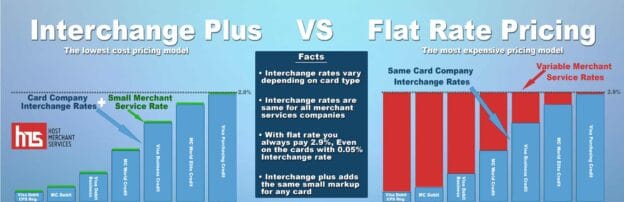
You pay the actual interchange and assessment costs for each transaction plus a fixed markup (e.g., interchange + 0.3% + 10¢). This model offers the most transparency because you see each cost component. It often yields lower costs for businesses with moderate or high volume, since you’re paying exact interchange rates and a modest markup.

Under interchange-plus, if a transaction’s interchange is 1.8% + $0.10, and your processor’s markup is 0.5% + $0.10, you know precisely how that 2.3% + $0.20 total breaks down.

Tip: Interchange-plus (also called “cost-plus”) is usually recommended if you want to ensure you’re not overpaying on each transaction.

  • Flat-Rate Pricing:

You pay a single flat rate on all transactions, regardless of card type. For instance, some providers charge 2.9% + 30¢ on everything. This model is simple and predictable – good for tiny businesses or those just starting, as you always know your fee.

However, the flat rate is often set on the high side to cover worst-case scenarios, so you could be overpaying on many transactions that qualify for lower interchange rates. In other words, the convenience might cost you extra if your sales volume grows.

  • Tiered (Bundled) Pricing:

The processor groups transactions into buckets like “Non-qualified,” “Qualified,” and “Mid-qualified,” each with a different rate. A non-reward consumer card swiped in-person might be “Qualified” at 1.7%, but a rewards or corporate card might be “Mid” or “Non-qualified” at a much higher rate. The interchange and markup are blended into these tiers, so you don’t see the exact breakdown.

Tiered plans are notorious for their lack of transparency and inconsistent charges – they can easily lead to overpaying, because many transactions are downgraded to higher-priced tiers even when they didn’t need to be. Processors also have leeway in defining the tiers. If you’re on a tiered plan and your statements show only a few rates, it’s hard to tell what the markup is or where you might be incurring unnecessary costs.

  • Match the model to your needs:

Take a look at your business’s size, transaction volume, and typical sale amount. Suppose you process a high volume of card sales. In that case, interchange-plus pricing is often the most economical and transparent choice, as you can negotiate a low markup and benefit directly when interchange rates drop or when you run more debit cards (which have low interchange).

Flat-rate might be fine for a small side business or hobby store for simplicity, but as you grow, it’s wise to move to a more granular pricing model to avoid built-in overpayments. If you’re currently on a tiered/bundled plan and suspect you’re paying too much, talk to your provider about switching to interchange-plus, or consider switching providers if they can’t offer it.

Also, remember that the right model for you can change over time. A pricing structure that was decent when you were smaller could become suboptimal as your average transaction size or volume changes.

Reevaluate periodically to ensure your plan still makes sense. For example, some businesses start on a flat rate for simplicity, then graduate to interchange-plus once their sales increase.

Regularly Review Rates and Negotiate with Your Processor

Don’t “set and forget” your credit card processing deal. The payments industry is competitive, and processors are often willing to adjust terms to keep your business, so it’s essential to review your rates at least once a year and negotiate when you have leverage. As your business grows or your transaction history strengthens, highlight improvements such as increased processing volume, low chargeback rates, and strong fraud prevention.

These factors position you as a lower-risk, high-value client and can justify requests for reduced markups or volume-based discounts. It also helps to compare offers from other processors, especially those with transparent interchange-plus pricing, so you have concrete quotes to use as negotiating leverage. Focus your negotiation on the processor’s markup and any monthly fees, since these are typically the most flexible. If you’ve demonstrated consistent or growing volume with few issues, ask for a pricing review and push for reductions, even if they seem small, as they can lead to substantial annual savings.

Be prepared to switch providers if your current one won’t adjust your rates, and you know better deals are available, keeping in mind any contract terms or potential early termination fees. Finally, make it a habit to review your statements regularly and check in with your provider annually to clarify any new fees or rate changes. Staying vigilant signals to your processor that you’re watching your costs closely and helps prevent unnecessary increases.

Minimize Fraud, Chargebacks, and Other Risk-Related Costs

Fraudulent transactions and chargebacks (customer disputes) are not only a headache – they also cost you money in fees and can lead to higher processing rates in the long run. Chargeback fees (an additional fee charged when a transaction is reversed) can range from $15 to $100 per incident, depending on your provider, and excessive chargebacks may even push your account into a higher-risk category.

Plus, when a chargeback occurs, you lose the sale amount and often the merchandise, effectively paying for an unfortunate event twice. Reducing these incidents will save you money, directly and indirectly.

Here’s how to keep these costs down:

  • Maintain PCI compliance: As mentioned earlier, being PCI DSS compliant (following the required security standards) not only avoids non-compliance fees but also reduces the chance of a costly data breach. Processors often charge lower fees to businesses they deem lower risk, including those that take security seriously.
  • Use fraud prevention tools: Enable tools like Address Verification Service (AVS) and card verification value (CVV) checks for online or keyed transactions. AVS checks the billing address against the one on file with the card issuer to help flag potential fraud. Using AVS can lower your interchange rates on some transactions or at least prevent “non-qualified” higher fees due to missing data. Many processors charge lower transaction fees for AVS/CVV-verified transactions because they’re considered lower risk. Additionally, consider using 3D Secure or fraud-detection filters, if your provider offers them, especially for e-commerce, to catch suspicious orders before they become chargebacks.
  • Set explicit billing descriptors: Ensure that the charge description your customers see on their card statement is recognizable (ideally, your DBA or store name) and includes a contact phone number. A surprising number of chargebacks happen simply because customers don’t recognize a charge on their statement and assume it’s fraud. A clear descriptor and an easy way to reach you can prevent misunderstandings from turning into disputes.
  • Streamline customer service and refund policy: Sometimes, customers initiate chargebacks out of frustration when they feel they can’t resolve an issue directly with the merchant. Make your refund and return policies clear and accessible, and provide prompt customer service. It’s often cheaper to issue a quick refund or resolve a complaint directly than to let it escalate into a chargeback (which costs more and potentially higher rates). If a customer contacts you with a billing issue, resolving it immediately can save you the ~$25 chargeback fee and protect your standing with processors.
  • Monitor your chargeback ratio: Keep an eye on your chargeback rate (disputed transactions vs. total transactions). If it’s creeping up, take action – find the root causes (product issues, fraud, unclear policies, etc.) and fix them. A consistently low chargeback rate strengthens your position when negotiating fees, whereas a high rate can lead to surcharges or even account termination with some providers.

Actively managing fraud and chargebacks, you’ll avoid many unnecessary fees and maintain a healthier relationship with your processor (which can translate into better rates). Think of fraud prevention as an investment that protects your revenue and keeps processing costs in check.

Optimize How Transactions Are Processed

The way you process transactions can significantly impact the fees you pay, and minor operational adjustments can help prevent transactions from falling into higher-cost categories. Using EMV chip or contactless methods for in-person sales ensures that transactions qualify for lower, more secure card-present rates, while swiping a chip card or keying in a number when the customer is standing in front of you can trigger expensive downgrades.

Daily settlement is equally important; if you don’t batch out within a day, many card networks reclassify the transaction at a higher interchange rate, so making end-of-day batching a routine practice keeps unnecessary fees at bay. You should also avoid manual key entry whenever possible, since keyed and card-not-present transactions generally cost more. When phone or online orders can’t be avoided, entering all requested verification data helps secure the lowest rate available for those transaction types.

A properly configured payment gateway is crucial for online payments as well, because missing or incomplete data can push transactions into higher-fee brackets. If you operate in a B2B environment, providing Level 2 or Level 3 data for corporate or government cards can significantly reduce interchange rates by supplying the detailed information card networks seek.

By optimizing these elements, using secure card-present methods, settling promptly, minimizing key-entry, ensuring complete data transmission, and enabling enhanced data levels where applicable, you can avoid preventable surcharges and consistently qualify for the most favorable processing rates.

Consider Passing Processing Fees to Customers (With Care)

Some businesses reduce their processing expenses by shifting a portion of those costs to customers, either by adding fees or offering incentives to use lower-cost payment methods. This approach must be carried out carefully to comply with legal and card network guidelines, but when done correctly, it can significantly offset payment processing costs. One method is applying credit card surcharges, which add a small percentage fee to transactions paid by credit card.

These are capped by card networks, subject to state laws, and require clear disclosure, advance notice to processors, and strict compliance rules. Debit cards cannot be surcharged, so staff must be trained to apply this correctly. When compliant, surcharging can help recover some or all of the processing fee on credit card transactions.

Another option is a cash discount program, where posted prices reflect the credit card price and customers receive a small discount for paying with cash or check. Because it’s framed as a discount rather than an additional fee, it is generally permitted even in places where surcharges are restricted. This gives customers an incentive to choose a lower-cost payment method while allowing card-paying customers to effectively cover the fee by not receiving the discount. Clear signage and transparent receipts help keep this approach compliant and customer-friendly.

Businesses can also establish a minimum purchase requirement for credit card use, typically set at $5- $10, to avoid losing money on small transactions. Since the fixed per-transaction processing fee makes tiny purchases disproportionately costly, setting a minimum helps ensure each sale remains profitable. It should apply only to credit card transactions and be clearly posted so customers understand the policy.

A fourth strategy is charging a convenience fee for payments made through alternate channels, such as phone or online, when these are not the business’s standard methods. These fees are usually flat amounts and must comply with card network definitions of what qualifies as an “alternative channel.” This approach is common for government agencies and utilities and can help recoup the higher processing costs associated with nonstandard payment methods.

While these tactics can meaningfully reduce expenses, they also affect the customer experience. Added fees may put some customers off, while others may appreciate cash discounts when framed positively. Since credit card users often spend more per transaction, it’s important to balance cost recovery with customer satisfaction and competitiveness. Observing what peers in your industry are doing and clearly communicating any policy, along with training staff to explain it politely, helps maintain goodwill while managing processing costs effectively.

Encourage Low-Cost Payment Alternatives

One of the simplest ways to avoid high card fees is to reduce your reliance on credit card payments when possible by steering customers toward cheaper payment methods.

  • Encourage debit card usage:

Debit cards usually have significantly lower interchange rates than credit cards. Because funds are drawn directly from the customer’s bank account, processing costs are often much lower. You can promote debit by displaying a “Debit card preferred” sign or by simply educating customers.

Some small businesses even offer a small discount for PIN debit transactions. If you have a keypad for PIN entry, encourage customers to use it. Over time, increasing debit usage and reducing rewards credit card swipes can lead to substantial savings.

  • Offer ACH or bank transfers for large payments:

For big-ticket invoices, common in B2B, professional services, or wholesale transactions, suggest or incentivize payment via ACH or direct bank transfer. ACH payments typically carry very low flat fees, making them far cheaper than paying a percentage-based card fee on large amounts. Businesses often use ACH for recurring billing or large one-time payments.

If a client typically pays $10,000 by credit card, offering a small discount or faster service for ACH or check payments can save both sides significant money. Even on smaller invoices, ACH usually costs a fraction of what card processing would, and fees often cap out at a low maximum regardless of transaction size.

  • Digital wallets and alternative payment platforms:

Depending on your customer base, offering options like Apple Pay, Google Pay, PayPal, Venmo, or Zelle can expand flexibility and sometimes reduce fees. While many wallet payments still run on traditional card rails, they often include enhanced security features, such as tokenization, that can reduce fraud and, in turn, lower costs by reducing chargebacks.

Some peer-to-peer apps now offer business profiles with competitive fee structures. It’s important to compare options carefully, as some platforms charge fees similar to credit cards while others may allow certain transactions at no cost.

  • Consider subscription or invoice models:

If it suits your business, switching to a subscription billing model can reduce the number of transactions you process. This doesn’t lower the percentage fee, but it does cut down on per-transaction fixed fees. Charging $120 once per year incurs only one fixed cost, whereas charging $10 monthly would incur 12 fixed costs.

Fewer transactions also reduce the chances of declines or chargebacks. While this is more of a strategic business model decision, it can indirectly reduce overall processing costs.

Conclusion

Credit card processing is a necessary cost of doing business in today’s world, but you should never just set it on autopilot and accept whatever fees come. With a bit of education and active management, you can significantly reduce these expenses. Start by understanding the fee components and reviewing your statements to find any charges that shouldn’t be there. Choose a pricing model that offers transparency and fairness for your sales volume, and don’t hesitate to negotiate – remember that processors want your business. You have more power if you shop around.

Improve your operations by preventing fraud and avoiding costly mistakes, such as late batch settlements or non-EMV transactions that trigger higher fees. And whenever appropriate, get creative by passing on costs in a customer-friendly way or encouraging payment methods that cost you less.

Frequently Asked Questions

  1. How can I tell if I’m overpaying for credit card processing?

    Review your monthly statements and look for unclear fees, rising markups, or tiered pricing that puts many transactions into “non-qualified” categories. If fees seem unpredictable or hard to understand, you’re likely overpaying.

  2. What is the most transparent pricing model for payment processing?

    Interchange-plus (cost-plus) pricing is the most transparent because it separates interchange, assessments, and the processor’s markup. This makes it easier to see exactly what you’re paying and where you can reduce costs.

  3. How often should I renegotiate my processing rates?

    At least once a year. As your business grows or your chargeback rate improves, you gain leverage to request lower markups or better terms. Regular rate reviews help prevent silent fee increases.

  4. Do operational habits really affect my processing fees?

    Yes. Using EMV chip/tap, batching daily, minimizing keyed transactions, and sending complete transaction data all prevent downgrades. These simple habits can significantly reduce your total processing cost.

  5. Is it legal to pass credit card fees to customers?

    Yes, in most places, but it must follow card-brand rules and state laws. Options include surcharging, cash discounts, minimum purchase requirements, or convenience fees—each with specific compliance requirements.

website banner 5 tips gunmerchant 1

What problems can gun merchants encounter with payment processing?

What Problems Can Gun Merchants Encounter With Payment Processing?

An excellent merchant account could make the payment processing very easy and straightforward. However, things could go wrong at sometimes. The people who have been in the gun business for a substantial period fully understand the challenges they face in their payment processing. Most merchants in the venture encounter a lot of trouble on drawing the proper applications. That makes all their efforts go to waste after the rejection from the merchant services processor.
Just like any other business around the competitive world, the success of a gun enterprise is highly depended on the merchants’ ability to accept any debit or credit card payments from their clients. One of the main reasons why you keep on experiencing the rejection is because the payment processor considered you as a highly risky enterprise. That would mean that they are not convinced that your business may live up to the agreement.
However, it is paramount to note that any rejection of a payment process is not the end of your businesses. There are many other options which you can exploit. Besides, you may need to understand several reasons why payment processors could be reluctant to work with you in any given business.
1. The type of business
Because of the several stringent restrictions found in various regulatory bureaus and federal governments, the firearm venture is considered a very high-risk industry. Hence, the risks involved in the business could make the payment processors cautious to work with several, gun merchants.
Besides, the concept of gun selling ventures is attracting polarizing opinions. That indicates that any payment processing or credit card processing firm could be reluctant to facilitate any firearm firm not to jeopardize their business reputation.
2. The various online operations
Some businesses identify payment processors which are known to offer quality gun merchant services. However, these merchant service providers end up rejecting their application. Some of the reasons could be based on the business set up. In most cases, a credit card processing provider will prefer working with a live establishment rather than an online store. That is because such establishment will not only attract few cases of fraud, but they are also well operated.
It is true that any payment processor shall consider your business a high risk if you are based online. Hence, the online store has minimal or slim chances of winning any gun merchants.
3. Poor Credit
Most credit processing companies accept firearm dealership after they prove that the gun dealer has been in the industry for long and have good credit records. An excellent history of debt settlement timelines is a clear indication that your firm is built on an incredibly loyal client base, and can maintain a secure income.

website banner 5 tips noshow lodge 1

What are no-show/ incidental indicators for hotels / lodging

What are no-shows/incidental indicators for hotels/lodging?

In the hospitality industry, a guest who arrives much later than planned, or who fails to arrive at all, is called a “no-show.” The charge the guest faces for not showing up is an incidental indicator, and it may affect payment processing. Understandably, having a no-show is frustrating for hoteliers, as it prevents other guests from staying at the hotel, and it may even cost the establishment money. Furthermore, hotel staff is put in the position of asking the individual why he or she did not show up, which can create an unpleasant situation for everyone.

While a no-show prevents another guest from using a room, it doesn’t always mean that the lodging facility loses money. Most payments are collected via websites or by phone, which gives hotel staff the opportunity to collect as much data as necessary to complete credit card processing even if the customer doesn’t show up or refuses to pay later on. Before charging a customer for merchant services, it’s a good idea to have a cancellation policy in place. That way, staff can explain policies to guests before they arrive and let them know what portion of the booked stay they’ll be responsible for paying in case they don’t make it. This policy is a win-win scenario for all, as it makes guests aware that they’ll be responsible for paying for having the room held, even if they don’t arrive as scheduled. It also authorizes hoteliers to carry out payment processing for up to 100% of the first night’s stay to avoid losing money from the hold. In addition to collecting 100% of the first night’s fee from a no-show, some establishments have other clauses in their cancellation policies that charge various amounts based on when the customer cancels. For instance, some establishments charge the guest a portion of the room fee for receiving notice within a certain period of time, which is normally up to 24 hours before the cancellation. Having a written policy in place allows lodging establishments to make their cancellation policies clear to customers. It also provides transparency into the entity’s merchant services. Having a concrete policy also makes it easier for lodging facilities to take the customer to small claims court if he or she breaches the contract and fails to provide payment as requested.

In addition to preventing financial loss in case of a no-show, a cancellation policy can help lodging establishments in other ways. By requesting advance notice of cancellation, they put pressure on guests to commit to staying at the establishment or provide plenty of time for the lodging facility to re-market the room to other guests. In doing so, the facility may be able to give a wait-listed guest a room or provide a current guest with a free upgrade.

website banner 5 tips cashadvance 1

Cash Advance – 5 tips for getting a good deal

As a business owner, you know that there are times when you need immediate access to cash. For various reasons, seeking a loan out via traditional lending institutions is not always in your best interest. Thankfully, merchant services are available with most online financial institutions. If you can properly manage your cash flow, getting money quickly should not be a problem. However, avoiding costly fees is obviously a primary concern. With that in mind, consider the following five tips for getting a good deal on a cash advance.

Manage Your Credit Score

It is important to maintain both your personal and business financial health in order to get the best rates. You will want to keep an eye on both credit scores, as this is what any lender will look at to determine the risk of providing access to quick money. The lower the perceived risk that you carry, the better your rate is likely to be in the end.

Maintain a Positive Daily Balance

It is important to demonstrate that you have the ability to make money, as this is how you will be paying back the advance that you ultimately do receive. The best way to do this is to show the lender that you can maintain a positive daily balance, primarily in the form of credit card processing receipts that you are able to show.

Avoid Delinquent Activity

Make sure that you demonstrate a record of always paying your loans back on time. Stay away from delinquent activity of any sort.

Make Use of Your Merchant Account

When you use your own merchant account for credit card processing, you will often be offered better rates on lending products. This is likely the quickest way to gain access to funding.

Provide Accurate Financial Information

You will want to provide lenders with access to your business financial information. Keep this information up to date and readily available.

If you can follow these five tips, you will be well positioned for getting a better deal on a cash advance than would otherwise be afforded to you. It is important to maintain your own financial health. If you do that, merchant services will become more readily available to you. This will help you manage your business flow and give you the breathing room that you need to succeed.

website banner Cash advance 1

Cash Advance – what you need to know

Getting a bank loan is not the only option available to people in need of cash. Neither is getting a high-interest payday loan from shady online lenders. There is the cash advance that is the alternative to short-term financial needs. Learn more about the different benefits of using this method to borrow money.

The Basics of Advancing Money

An advance allows for the withdrawal of cash from your credit line. The withdrawal limit is based on a certain percentage or the total amount of credit in your account. For each advance, there is a 3 to 5% fee based on the amount. Borrowers pay compound interest, making this withdrawal more expensive than some loans.

Withdraw this cash at an ATM or bank like a debit card transaction. However, this advance is a loan that must be repaid. Some people claim that receiving this money is convenient, but others claim that the fees make it an expensive long-term option.

The Benefits of Merchant Cash Advances 

These advances are extended to merchant services. Business owners borrow merchant cash advances that work similarly to loans. However, they make repayments using the money that they earn on their credit card sales.

Qualifying to obtain an advance is easier than qualifying for a regular business loan. Borrowers do not need good credit, but they must have tools for credit card processing. They also need to show proof of stable credit card earnings. Any business owner who makes steady monthly sales will have no problems in repaying the money.

Completing the application for a merchant advance is less complicated. On average, it takes several hours or days to get approved. This is shorter than the few weeks or months that it takes to get a bank loan.

There are money advances available to both individuals and businesses. The process of withdrawing cash from a personal bank account is convenient yet expensive in the long run. For merchants, receiving an advance is simple and possible for any business to do regardless of credit. In general, this method is one of the fastest and easiest ways to borrow money.

website banner POS 1

Upgrade your point of sale system

Upgrading a POS system is something all businesses have to consider at some point. While the older system may be perfectly capable of meeting credit card processing needs, upgrades are sometimes necessary. Here are some clear signs that it is time to upgrade your point-of-sale system.
Energy costs
In looking for ways to cut energy costs, one of the most overlooked options is cutting down on computer-related costs. In storing a solution and all of the hardware onsite, you have not only reduced the amount of space available to you, but you have also increased hardware costs. Older hardware solutions require more energy consumption. Storing a server onsite increases energy costs. Hosted, cloud solutions online reduce energy costs.

Hardware challenges

Older hardware is prone to more malfunctions. Monitors break down. Printers don’t print reliably. POS systems that are outdated are at increased risk of complete system failure. Replacing parts that are older are more costly. Frequent repairs are something that is common when dealing with older systems. As the costs add up, it may be sensible to consider an upgrade to a low maintenance, cloud-based solution that is managed virtually with ease. With most of the budget being directed toward managing the older system, there is little room for expansion and adding more terminals or resources to power the solution.

EMV and NFC

EMV and NFC payments are commonplace in retail environments when it comes to merchant services. The cards are designed to provide increased security parameters to safeguard sensitive customer data. Cards featuring the magnetic strips have enhanced security, so they are far less vulnerable to hacking and unauthorized access to data. NFC solutions enabled by chip technology permits contactless pay. Both technologies for credit card processing are easily supported in newer point-of-sale systems and aren’t supported as easily in their predecessors. Apple Pay and Android Pay are examples where contactless pay solutions and antiquated point-of-sale systems could prove problematic for businesses.

Expansion opportunities 

Your system has to be able to support your ever-expanding product line. You don’t want your system to be incapable of handling the addition of more terminals as the business grows. Cloud solutions offered by merchant services tend to be more scalable in nature. If your system isn’t designed to grow your business, you run the risk of losing out on future business opportunities using outdated credit card processing systems.

Clunky systems

A clunky system is something that can hinder a business. Handling higher volumes of business during busier cycles requires the latest point-of-sale technologies. You want to have a streamlined user experience as employees interact with the system. There are consultants that work with merchant services that can assist with matching companies to the right solutions.

These are indicators that it may be time to consider upgrading your point-of-sale system. In considering an upgrade, the solution should be aligned with future expansion efforts. The POS system must accommodate increased data, operate with improved efficiency, and meet new business needs.

Virtual Credit Cards

How are virtual credit cards affecting your business?

Regarding credit card processing for your business, have you ever considered using virtual credit cards? They are digital numbers that represent a plastic credit card. With the right card, your customers can often decide the maximum amount that can be charged to the card. They can also set an expiration date for the card so it cannot be used for over one year. Many consumers are embracing virtual credit cards because they protect their actual credit card numbers from most businesses.

Since consumers are getting in on the virtual credit card, you might wonder if your business can do the same. Protecting corporate credit card accounts is now being accomplished with virtual cards. Many top credit card companies worldwide use this technology to their advantage.

Businesses and Virtual Credit Cards

Businesses and Virtual Credit Cards

There is more than one use for corporate virtual credit cards. Businesses now use them for employee expenses such as travel and invoice payments. These days, almost 40% of all companies that process payments electronically use virtual credit cards for this purpose.

Depending on the size of your business, you may greatly benefit from their use. Most small businesses are discovering that business credit cards give them fewer options than virtual cards. Issuing a corporate credit card to eligible employees can be quite an undertaking, but virtual cards make it much more manageable. They provide a great alternative to your employees using their credit cards for business expenses and eliminate the need for them to submit paperwork to receive reimbursement.

Advantages of Virtual Credit Cards

Advantages of Virtual Credit Cards

Security Benefits

One primary advantage of virtual credit cards is enhanced security. Unlike traditional credit cards, virtual cards come with dynamic numbers generated for each transaction, reducing the risk of fraud and unauthorized use. Additionally, virtual cards can be easily deactivated or restricted, giving businesses greater control over spending.

Convenience and Flexibility

Virtual credit cards offer unparalleled convenience and flexibility, allowing businesses to purchase online without needing physical cards. It makes them ideal for remote work environments and business travel, where access to physical cards may be limited. Moreover, online banking portals can easily manage and track virtual cards, giving businesses real-time visibility into their expenses.

Cost-Effectiveness

Virtual credit cards can also lead to cost savings for businesses. Companies can reduce administrative overhead and streamline their payment workflows by eliminating the need for physical cards and paper-based processes. Additionally, virtual cards may offer rewards and incentives similar to traditional credit cards, further enhancing cost-effectiveness.

Challenges and Risks

Despite their numerous benefits, virtual credit cards also present specific business challenges and risks.

Fraud and Security Concerns

While virtual credit cards offer enhanced security features, they are not immune to fraud and security breaches. Cybercriminals may attempt to intercept card details or exploit vulnerabilities in online payment systems, posing a risk to businesses and their financial assets.

Limited Acceptance

Another challenge associated with virtual credit cards is their limited acceptance. While virtual cards can be used for most online transactions, some merchants may not accept them or impose additional fees. It can inconvenience businesses and limit their ability to leverage virtual cards for all their purchasing needs.

Potential for Overspending

Virtual credit cards may also pose a risk of overspending for businesses. The ease of making online purchases with virtual cards can lead to impulsive buying behavior and unchecked spending. To mitigate this risk, companies must establish clear spending limits and controls for virtual card usage.

Impact on Business Operations

Virtual Credit Cards - Impact on Business Operations

Despite these challenges, virtual credit cards profoundly impact business operations.

Streamlining Payments

Virtual credit cards streamline the payment process for businesses by providing a convenient and secure online purchase method. By digitizing their payment workflows, companies can eliminate manual processes and reduce the risk of errors and delays.

Enhanced Security Measures

Virtual credit cards offer enhanced security measures compared to traditional credit cards. With features such as dynamic card numbers and real-time transaction monitoring, businesses can better protect themselves against fraud and unauthorized use.

Improved Expense Tracking

Virtual credit cards enable businesses to track their expenses more effectively. By consolidating all transactions into a single online portal, companies can easily monitor their spending patterns and identify areas for cost savings and optimization.

Adoption Trends

The adoption of virtual credit cards is on the rise across various industries.

Growth in Virtual Credit Card Usage

Businesses are increasingly recognizing the benefits of virtual credit cards and are adopting them rapidly. According to industry reports, the global market for virtual credit cards is expected to grow significantly in the coming years, driven by factors such as increasing digitization and the need for enhanced security.

Industries Benefiting the Most

Specific industries stand to benefit the most from the adoption of virtual credit cards. These include e-commerce, travel and hospitality, and professional services, where online transactions are prevalent and security is paramount.

Integration with Accounting Systems

Virtual credit cards can seamlessly integrate with accounting systems, providing businesses with greater automation and efficiency.

Automation and Efficiency Gains

By integrating virtual credit cards with accounting software, businesses can automate the reconciliation process and eliminate manual data entry. It saves time and reduces the risk of errors, allowing companies to focus on more strategic activities.

Compatibility with Popular Software

Virtual credit cards are compatible with various accounting software, including QuickBooks, Xero, and FreshBooks. It makes it easy for businesses to integrate virtual card transactions into their existing workflows and reporting processes.

Regulatory Compliance

Businesses must ensure compliance with regulatory requirements when using virtual credit cards.

Compliance Requirements

Virtual credit cards are subject to the exact regulatory requirements as traditional credit cards, including data security standards such as PCI DSS. Businesses must adhere to these regulations to protect sensitive customer information and avoid potential fines and penalties.

Implications for Businesses

Non-compliance with regulatory requirements can seriously affect businesses, including reputational damage and financial losses. Therefore, companies must implement robust security measures and compliance programs to safeguard against potential risks.

Strategies for Effective Implementation

Businesses can maximize the benefits of virtual credit cards through effective implementation strategies.

Employee Training and Education

Providing employees with training and education on using virtual credit cards is essential for successful implementation. It ensures employees understand how to use virtual cards responsibly and know security best practices.

Setting Spending Limits and Controls

Businesses should establish clear spending limits and controls for virtual card usage. It helps prevent overspending and unauthorized transactions, ensuring that virtual cards are used responsibly.

Regular Audits and Monitoring

Regular audits and monitoring of virtual card transactions are crucial for detecting and preventing fraud. Businesses should conduct periodic reviews of their virtual card activity to identify suspicious or unauthorized transactions and take appropriate action.

Case Studies

Several businesses have successfully implemented virtual credit card programs.

Examples of Successful Implementation

Companies like XYZ Inc. and ABC Corp. have implemented virtual credit card programs to streamline payment processes and enhance security. By leveraging virtual cards, these companies have reduced administrative overhead and mitigated the risk of fraud.

Lessons Learned from Real-World Experiences

From these case studies, businesses can learn valuable lessons about the benefits and challenges of virtual credit card usage. By studying the experiences of others, businesses can better understand how to implement virtual card programs and maximize their benefits effectively.

Future Outlook

The future of virtual credit cards looks promising, with continued innovation and adoption expected in the coming years.

Predicted Trends in Virtual Credit Card Usage

Industry experts predict that virtual credit card usage will grow as businesses seek more secure and efficient payment solutions. Technological advancements such as tokenization and biometric authentication are expected to enhance virtual card security and usability further.

Technological Advancements

Advancements in technology will drive further innovation in virtual credit card offerings. For example, the integration of virtual cards with mobile payment platforms and digital wallets will make them even more convenient and accessible for businesses and consumers alike.

Conclusion

In conclusion, virtual credit cards are revolutionizing the way businesses conduct transactions. With their enhanced security features, convenience, and cost-effectiveness, virtual cards offer numerous benefits for businesses of all sizes. However, companies must also be aware of the challenges and risks associated with virtual credit card usage and implement robust security measures and compliance programs to mitigate these risks effectively.

FAQs

  1. What are virtual credit cards?

    Virtual credit cards are digital representations of traditional credit cards that can be used for online transactions.

  2. How secure are virtual credit cards compared to traditional ones?

    Virtual credit cards offer enhanced security features such as dynamic card numbers and real-time transaction monitoring, making them more secure than traditional credit cards.

  3. Can virtual credit cards be used for international transactions?

    Yes, virtual credit cards can be used for international transactions, provided the merchant accepts them and any applicable currency conversion fees are paid.

  4. Are there any fees associated with virtual credit cards?

    Some financial institutions may charge fees for virtual credit card issuance or usage. However, these fees are typically lower than those of traditional credit cards.

  5. How can businesses mitigate the risks associated with virtual credit cards?

    Businesses can mitigate the risks associated with virtual credit cards by implementing robust security measures, such as setting spending limits and controls, conducting regular audits and monitoring, and ensuring compliance with regulatory requirements.

Chili's Data Breach

Chili’s data breach announced

Data breaches have become a significant concern for businesses and consumers in recent years. One such incident that garnered attention was the Chili’s data breach, which raised questions about cybersecurity practices and the protection of customer information.

Chili’s Data Breach

Chili’s, renowned for its Tex-Mex cuisine, faced a significant data breach that profoundly impacted its operations and customer trust. This breach underscored the vulnerabilities within modern businesses’ digital frameworks, emphasizing the critical necessity for robust cybersecurity measures. As a popular restaurant chain, Chili’s breach served as a wake-up call, echoing the broader trend of cyber threats targeting businesses globally. The incident not only compromised sensitive customer data but also shook the foundation of trust that customers place in companies to safeguard their information. Consequently, Chili’s and other businesses were compelled to reassess their cybersecurity strategies, recognizing the imperative of fortifying their digital infrastructure against evolving cyber threats to preserve customer trust and uphold their reputation.

What Happened in the Chili’s Data Breach?

What Happened in the Chili's Data Breach

The Chili’s data breach resulted from unauthorized entry into its systems, compromising sensitive customer data. Hackers targeted vulnerabilities within the restaurant’s payment processing systems, enabling them to access the credit and debit card details of patrons who had dined at specific locations. This breach not only breached Chili’s security protocols but also jeopardized its customers’ privacy and financial security. Such unauthorized access highlights the constant threat cybercriminals pose to businesses and individuals. Like many other companies, Chili fell victim to these sophisticated cyber attacks, emphasizing the importance of implementing robust cybersecurity measures to safeguard customer information and prevent future breaches.

Impact of the Data Breach

Financial Losses

The Chili’s data breach inflicted substantial financial consequences. The company bore the burden of legal expenses, fines, and compensating affected customers, leading to significant economic losses. Moreover, the incident triggered a downturn in sales and decreased stock value, adversely affecting Chili’s bottom line. This breach incurred immediate financial costs and tarnished the restaurant chain’s reputation, potentially leading to long-term repercussions. Like many businesses, Chili’s faced the dual challenge of managing both the financial fallout and rebuilding trust with customers in the aftermath of the breach.

Reputation Damage

The data breach severely damaged Chili’s reputation as a reliable dining destination. Word of the breach quickly circulated, stirring unease among current patrons and dissuading prospective ones. Trust erosion could have lasting ramifications for Chili’s brand perception and customer allegiance. Rebuilding trust requires transparent communication and concrete actions to address the breach’s aftermath. Like any business facing a violation, Chili’s must work diligently to restore confidence in its commitment to customer security and privacy. Failure to do so risks short-term repercussions and enduring harm to its reputation and market standing.

Customer Trust Erosion

Chili’s data breach profoundly impacted customer trust, arguably its most damaging consequence. Many felt betrayed and vulnerable upon learning their personal information was compromised. Rebuilding trust necessitates Chili’s commitment to transparent communication and tangible measures. Openly addressing the breach, providing security enhancements updates, and assisting affected customers are crucial steps. Demonstrating accountability and prioritizing customer security can help Chili regain trust and confidence. However, restoring trust is a continual process that requires sustained effort and vigilance to reassure customers of their safety and privacy. Chili must remain proactive in its response to the breach to rebuild and maintain trust in the long term.

Response and Actions Taken

Investigation

Upon detecting the breach, Chili swiftly initiated an exhaustive investigation to gauge its scope. They enlisted forensic experts to meticulously analyze to the violation and uncover any vulnerabilities in Chili’s systems. This proactive approach demonstrated Chili’s commitment to addressing the issue promptly and comprehensively. By conducting a thorough investigation, Chili aimed to understand the extent of the incident and implement effective measures to prevent similar breaches. This proactive stance underscores Chili’s dedication to safeguarding customer data and serves as a model for other businesses facing similar challenges.

Communication with Customers

Chili’s proactively engaged with affected customers by promptly notifying them of the breach and providing guidance on protecting their financial data. Transparent and timely communication played a pivotal role in minimizing the repercussions of the breach and restoring trust with customers. By openly addressing the situation and offering support, Chili demonstrated accountability and a commitment to customer welfare. This approach helped alleviate concerns among affected patrons and showcased Chili’s dedication to prioritizing customer security. Such proactive communication is essential in mitigating the impact of data breaches and fostering long-term trust and loyalty among customers.

Security Enhancements

In light of the data breach, Chili took decisive action by bolstering its security measures to prevent future incidents. This involved upgrading encryption protocols, implementing multi-factor authentication, and conducting routine security audits. These proactive steps aimed to strengthen Chili’s systems against potential vulnerabilities and thwart any future cyber attacks. By investing in enhanced security measures, Chili’s demonstrated a commitment to safeguarding customer data and protecting against unauthorized access. This proactive approach helps mitigate the risk of future breaches and reinforces Chili’s reputation as a responsible custodian of sensitive information.

Lessons Learned from Chili’s Data Breach

Lessons Learned from Chili's Data Breach

Importance of Cybersecurity Measures

The Chili’s data breach emphasized the vital significance of robust cybersecurity measures in protecting customer data. It served as a stark reminder for businesses to prioritize investments in cybersecurity and implement proactive strategies to mitigate risks and threats effectively. In today’s digital landscape, where cyber attacks are prevalent, safeguarding sensitive information is paramount. Companies must recognize the potential consequences of lax cybersecurity protocols and take proactive steps to fortify their defenses. By prioritizing cybersecurity investments and adopting proactive measures, businesses can better safeguard customer data, maintain trust, and mitigate the financial and reputational damages associated with data breaches.

Vigilance in Handling Customer Data

The incident served as a reminder of businesses’ responsibility to protect customer data. It underscored the crucial need for vigilance and diligence in safeguarding sensitive information and preventing unauthorized access. Maintaining robust security measures is imperative in today’s interconnected digital landscape, where data breaches are a looming threat. Businesses must remain vigilant in monitoring their systems, identifying potential vulnerabilities, and implementing stringent security protocols. By prioritizing the protection of customer data, companies not only fulfill their ethical obligations but also mitigate the risks of financial losses and reputational damage associated with data breaches. This incident serves as a wake-up call for businesses to prioritize cybersecurity and uphold the trust of their customers.

Preventive Measures for Businesses

Data Encryption

Encrypting sensitive data provides additional protection against unauthorized access and potential data breaches. By implementing robust encryption protocols, businesses can effectively secure customer information and mitigate the risk of cyber threats. Robust encryption algorithms scramble data into unreadable formats, making it difficult for unauthorized parties to decipher. It helps safeguard sensitive information, such as personal and financial data, from being compromised. Businesses should prioritize adopting encryption technologies to ensure the confidentiality and integrity of customer data. By implementing strong encryption measures, companies can enhance their cybersecurity posture and build trust with their customers, demonstrating a commitment to protecting their privacy and security.

Regular Security Audits

Regular security audits and assessments are critical in identifying vulnerabilities and weaknesses within a company’s digital infrastructure. These audits involve thoroughly examining systems, processes, and protocols to pinpoint potential security gaps. By conducting comprehensive audits, businesses can proactively detect and address security threats before malicious actors exploit them. This proactive approach helps safeguard sensitive data and ensures compliance with regulatory requirements. Additionally, regular security audits instill confidence among customers and stakeholders, demonstrating a commitment to maintaining a secure and trustworthy environment. Investing in regular security assessments is essential for bolstering cybersecurity defenses and mitigating the risk of data breaches and cyber-attacks.

Employee Training

Educating employees about cybersecurity best practices is paramount in preventing data breaches. Training programs should encompass a range of topics, including phishing awareness, password security, and incident response protocols. By providing comprehensive training, businesses empower employees to effectively recognize and respond to potential threats. Phishing awareness training, for instance, teaches employees to identify suspicious emails and avoid falling victim to phishing scams. Password security training emphasizes the importance of creating strong, unique passwords and regularly updating them. Additionally, educating employees on incident response protocols ensures they know how to report security incidents promptly. By investing in cybersecurity training, businesses can foster a culture of security awareness and equip employees with the knowledge and skills needed to mitigate cyber risks effectively.

Conclusion

The Chili’s data breach is a cautionary tale for businesses in the digital age. It highlights the far-reaching consequences of inadequate cybersecurity measures and the importance of proactive risk management strategies. By learning from this incident and implementing preventive measures, businesses can better protect themselves and their customers from future data breaches.

FAQs

  1. How did the Chili’s data breach occur?

    The data breach at Chili’s resulted from unauthorized access to its payment processing systems, allowing hackers to obtain sensitive customer information.

  2. What information was compromised in the Chili’s data breach?

    The data breach exposed the credit and debit card information of customers who dined at specific Chili’s locations.

  3. How did Chili respond to the data breach?

    Chili’s responded to the data breach by investigating, communicating with affected customers, and implementing enhanced security measures.

  4. What are some preventive measures businesses can take to avoid data breaches?

    Businesses can prevent data breaches by implementing data encryption, conducting regular security audits, and providing employee training on cybersecurity best practices.

  5. What lessons can businesses learn from the Chili’s data breach?

    The Chili’s data breach underscores the importance of prioritizing cybersecurity measures, handling customer data with vigilance, and investing in proactive risk management strategies.

website banner salon merchant2 1

Payment Processing for Salons: What You Should Know

The advent of social media platforms such as Instagram has been a boon for hair and beauty salons. As the most popular photo sharing social network, Instagram is redefining personal style and aesthetics; users of this network, particularly women, will often share photos that highlight salon services they recently received and paid for. As can be expected, followers of Instagram users whose hair, makeup, nails, and skin are always looking great are often asked for recommendations, and this is an excellent great marketing opportunity for salons.

While salon operators will certainly welcome an influx of new customers coming from Instagram, they should be prepared to deal with the payment demands of a young, tech-savvy crowd. A young woman whose life is ruled by her smartphone and a few mobile apps, and who wants her hair and nails done every Friday, is not likely to pay cash; at the minimum, she will pay with a credit or debit card, but she may prefer to do so via a mobile app.

A solid payment processing and solution is essential for today’s salon operators. Simply installing a credit card machine to accept Visa and MasterCard payments is no longer acceptable for salon operators; it is more important to choose a provider that can handle more than just credit card processing.

If you are the owner or manager of a beauty salon, the first thing you should look for when evaluating merchant services providers is their level of involvement in your particular industry. One observation to make in this regard is whether the provider offers a point of sale (POS) terminal or software specifically developed for salons, ideally one that features built-in payment processing options or that connects to a legacy credit card machine.

Advanced POS solutions offer customer relationship management (CRM) functionality to connect with social media platforms such as Instagram and Facebook. If your customers are not coming from social media, a CRM strategy can point you in the right direction.

Credit card processing is just one of the pieces of the merchant services puzzle for salon owners. You will want an option that allows you to collect and distribute tips that customers wish to leave for your staff. Even though all stylists love getting cash tips from customers who place them inside neat envelopes, this custom has been mostly abandoned. Your POS system should allow customers to tip from their credit cards, and it should also route tips for you.

Chargeback and fraud protection are two other features that you should consider when choosing a merchant services provider for your salon. The last thing you want is a breach of your salon’s payments processing system, such a situation could put your customer’s financial data at risk; to this effect, your system should offer endpoint security and encryption.